Time to read: 20 min
Everything You Should Know About Copper Materials for Custom Parts
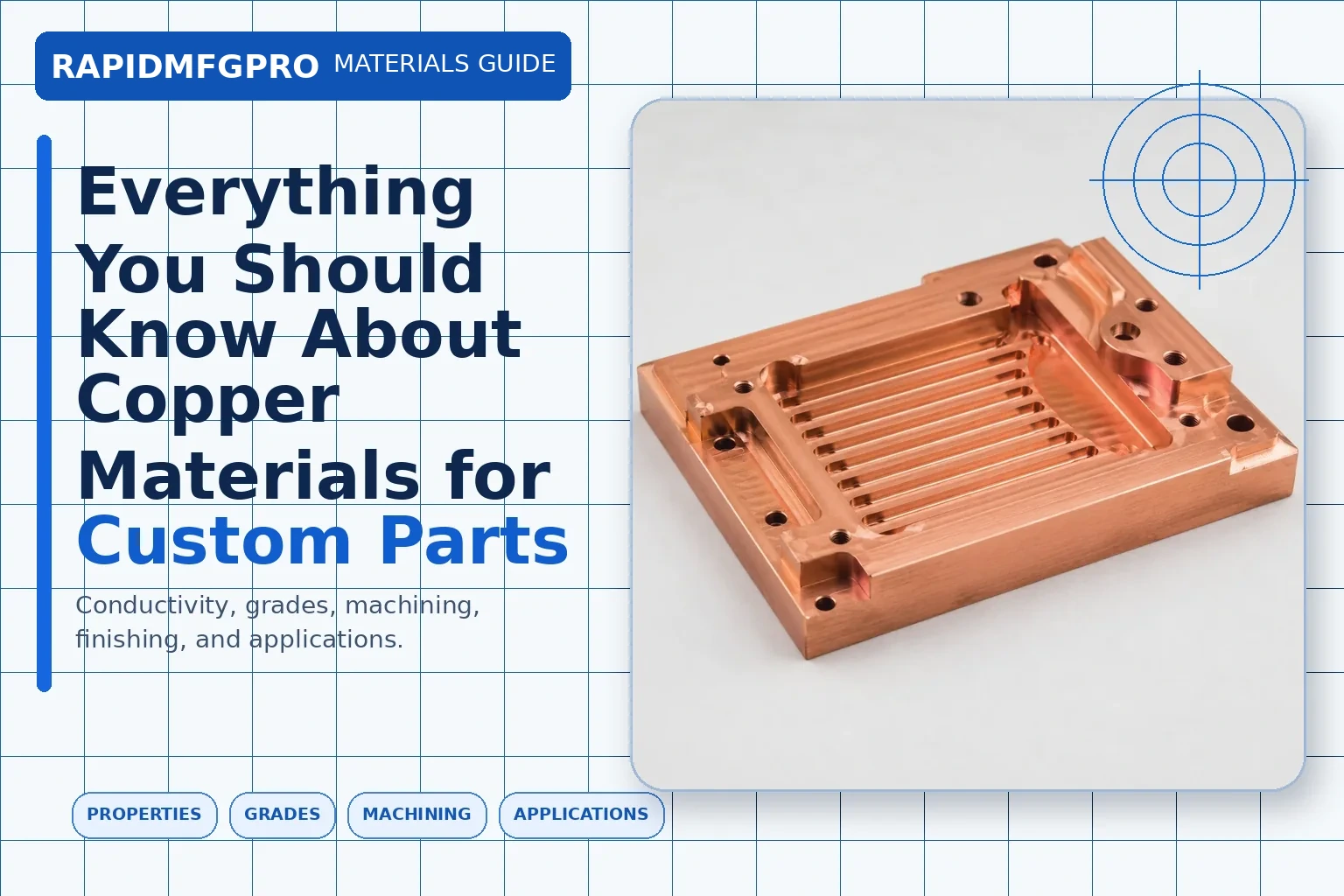
Copper is one of the most important engineering metals for electrical, thermal, fluid, decorative, and corrosion-sensitive components. It is used in busbars, terminals, heat exchangers, cooling plates, connectors, electrodes, plumbing parts, optical hardware, medical equipment, industrial machinery, and consumer products.
However, copper is not one single material. Commercially pure copper, oxygen-free copper, brass, bronze, copper-nickel, beryllium copper, chromium copper, and tellurium copper have very different machining behavior, strength, conductivity, corrosion resistance, formability, and cost.
A copper grade that works well for an electrical busbar may be too soft for a wear component. A free-machining copper alloy may be easier to cut but provide lower conductivity. A corrosion-resistant copper-nickel alloy may perform well in seawater but be unnecessary for a dry indoor connector.
RapidMFGPro evaluates copper projects from a manufacturing supplier-matching perspective. The platform reviews the required copper grade, product form, quantity, geometry, conductivity target, finish, inspection method, and documentation before identifying suppliers with relevant machining, fabrication, casting, plating, and quality-control capabilities.
This guide explains how copper materials differ, how to choose a suitable grade, how copper parts are manufactured, and what engineers and buyers should confirm before production.
Why Do Engineers Choose Copper?
Copper is selected when a component must transfer electricity, transfer heat, resist corrosion, form into a complex shape, or provide a stable metallic surface. Its value usually comes from one dominant functional requirement.
Electrical Performance
Copper provides very high electrical conductivity. This makes it a primary material for conductors, busbars, terminals, grounding parts, contacts, windings, and power-distribution components.
Conductivity still varies by grade, temper, cold work, heat treatment, and alloying content. A high-strength copper alloy may not conduct electricity as effectively as commercially pure copper.
Thermal Performance
Copper transfers heat rapidly and is used where heat must be moved away from a source or distributed evenly across a surface.
Typical products include heat exchangers, heat spreaders, cold plates, cooling blocks, induction coils, heat pipes, and mold components.
Corrosion Performance
Copper and many copper alloys resist atmospheric corrosion and selected fluids. Their behavior depends on alloy composition, temperature, flow, oxygen level, chemical exposure, and galvanic contact.
Copper-nickel alloys are especially valuable in marine systems, while brasses and bronzes are widely used in water-handling and industrial hardware.
Forming Performance
Many copper grades can be bent, stamped, drawn, rolled, spun, or forged. High ductility allows thin conductors, shells, contacts, clips, and complex formed parts to be produced efficiently.
Formability depends on alloy and temper. A soft annealed copper sheet behaves very differently from a hardened spring copper strip.
Surface Appearance
Copper provides a distinctive metallic appearance and develops a natural patina over time. It can also be polished, brushed, plated, lacquered, painted, blackened, or coated.
Decorative requirements should define whether natural color change is acceptable or whether the surface must remain bright and controlled.
When Is Copper Not the Best Choice?
Copper can be expensive, heavy, soft, and difficult to machine in certain conditions. It should not be selected automatically when a lower-cost or lighter material can meet the requirement.
Weight-Sensitive Structures
Copper is significantly denser than aluminum. A large copper housing, plate, or structural bracket can add substantial mass.
Aluminum may be more suitable when the main requirement is lightweight thermal management or a low-mass electrical enclosure.
Low-Cost Structural Parts
Carbon steel, stainless steel, or aluminum may be more economical for brackets, frames, bases, and covers that do not require copper conductivity.
Copper should provide a measurable functional benefit that justifies raw-material cost and machining loss.
High-Wear Surfaces
Pure copper is relatively soft and may wear, deform, or gall under concentrated contact.
Bronze, beryllium copper, steel, or a coated material may perform better when wear resistance is more important than maximum conductivity.
High-Temperature Structures
Copper transfers heat well, but pure copper can lose strength as temperature rises. It may not be suitable as a load-bearing material in prolonged high-temperature service.
Chromium copper, nickel alloys, stainless steels, or refractory metals may be considered when both thermal performance and elevated-temperature strength are required.
Unprotected Contact With Aluminum
Copper and aluminum can create galvanic corrosion when they are electrically connected in the presence of moisture.
Transition materials, plating, sealing, joint compounds, controlled hardware, or isolation may be required.
| Part Requirement | Copper Suitability | Reason |
|---|---|---|
| High-current busbar | High | Electrical conductivity is the main requirement |
| Lightweight machine frame | Low | Aluminum or steel is usually more practical |
| Heat spreader | High | Copper transfers heat efficiently |
| Sliding wear component | Conditional | A bronze or hardened copper alloy may be required |
| Marine condenser tube | High | Copper-nickel alloys can perform well in seawater |
| Low-cost indoor cover | Low | Copper adds cost without clear functional value |
What Is Copper?
Copper is a metallic chemical element and the base material for a large family of engineering alloys. It is known for high conductivity, good ductility, useful corrosion resistance, and a distinctive reddish metallic color.
Copper as an Element
Copper has the chemical symbol Cu and atomic number 29. It occurs naturally in mineral deposits and can also be found in native metallic form.
After mining, concentration, smelting, refining, and casting, copper is converted into sheet, plate, bar, tube, wire, strip, billet, and other industrial forms.
Copper as an Engineering Material
Engineering copper may be commercially pure or alloyed with zinc, tin, nickel, aluminum, silicon, beryllium, chromium, tellurium, lead, or other elements.
These additions change strength, conductivity, machinability, casting behavior, corrosion resistance, spring performance, and wear behavior.
Copper Product Forms
Product form influences manufacturing method, material properties, lead time, and cost.
Common copper product forms include:
- Sheet
- Plate
- Strip
- Round bar
- Rectangular bar
- Tube
- Wire
- Forged billet
- Cast blank
- Extruded profile
A busbar cut from plate requires different manufacturing resources from a turned brass fitting or an investment-cast bronze housing.
How Does Copper Conduct Electricity?
Copper is widely used as an electrical conductor because electrons move through it with relatively low resistance. Grade purity and processing condition strongly affect this behavior.
Electrical Conductivity
High-purity copper grades can reach conductivity values close to or above the conventional reference used for electrical copper. Alloying additions normally reduce conductivity.
Conductivity should be specified when it affects current capacity, voltage drop, heating, or product efficiency.
Contact Resistance
The electrical resistance of a joint depends on more than bulk conductivity. Surface oxide, flatness, contact pressure, plating, contamination, and fastener torque all affect contact resistance.
Critical joints may require silver plating, tin plating, nickel underlayers, controlled surface roughness, or defined assembly pressure.
Current Density
Current density determines how much electrical current passes through a given cross-sectional area. Excessive current density can increase temperature and accelerate joint degradation.
Busbar thickness, width, cooling, ambient temperature, enclosure design, and allowable temperature rise should be considered together.
Conductivity After Machining
Normal CNC machining does not remove the bulk conductivity of copper, but surface contamination, coatings, heat, burrs, or poor contact geometry can affect the performance of the finished part.
Electrical contact areas should be protected from nonconductive coatings unless the design intentionally isolates them.
How Does Copper Transfer Heat?
Copper is one of the most effective commonly available engineering metals for thermal transfer. It is selected when rapid heat movement or uniform temperature distribution is more important than weight.
Thermal Conductivity
Pure copper generally provides higher thermal conductivity than most copper alloys. Alloying elements, cold work, and impurities can reduce heat-transfer performance.
The actual grade should be used in thermal calculations rather than a general copper value.
Heat Spreading
Copper heat spreaders distribute concentrated heat across a larger surface before transferring it to a heat sink, coolant channel, or surrounding structure.
Flatness, thickness, interface material, mounting pressure, and surface roughness influence thermal contact.
Liquid Cooling
Copper is used for cold plates, water blocks, manifolds, and heat-exchanger components because it combines thermal performance with good manufacturability.
Fluid compatibility, corrosion inhibitors, brazing, sealing, channel geometry, leak testing, and galvanic contact with aluminum should be reviewed.
Thermal Expansion
Copper expands when temperature rises. Mixed-material assemblies can develop stress when copper is joined to aluminum, steel, ceramic, or plastic.
Joint design should allow for differential expansion during thermal cycling.
How Strong Is Copper?
Copper strength ranges from soft and highly formable to high-strength spring alloys. The selected grade, temper, cold work, heat treatment, and product form determine the mechanical performance.
Yield Strength
Annealed pure copper has relatively low yield strength and deforms easily. Cold-worked copper and copper alloys can provide much higher yield strength.
Yield strength is important for clips, terminals, busbars, brackets, pressure parts, and formed components.
Tensile Strength
Tensile strength varies widely across copper materials. High-strength copper alloys may approach the performance of some steels while retaining useful conductivity.
Tensile strength should be evaluated together with elongation, fatigue, hardness, and service temperature.
Fatigue Strength
Electrical contacts, springs, flexible connectors, and vibration-loaded parts may fail through fatigue.
Sharp corners, stamping marks, scratches, plating defects, and residual stress can reduce fatigue life.
Creep Resistance
Soft copper can deform gradually under load, especially at elevated temperature. This may reduce clamping force in bolted electrical joints.
Joint design, grade selection, spring washers, contact systems, and maintenance requirements should account for creep.
How Does Copper Resist Corrosion?
Copper forms surface oxides and corrosion products that can slow further attack in many environments. The appearance and protection of these films depend on atmosphere, moisture, chemicals, and alloy.
Atmospheric Exposure
Copper initially darkens and can develop brown, black, or green surface films during long-term exposure.
This patina may protect the underlying material, but it changes appearance and may not be acceptable for electrical contact surfaces.
Water Exposure
Copper and copper alloys are widely used in water systems, but corrosion behavior depends on water chemistry, velocity, dissolved gases, temperature, and contaminants.
High flow can cause erosion-corrosion, while stagnant conditions can create deposits and localized attack.
Marine Exposure
Copper-nickel alloys are widely used in seawater piping and heat exchangers because of their resistance to marine corrosion and biofouling.
Grade, flow rate, startup conditions, and system design remain important.
Galvanic Contact
Copper can accelerate corrosion of less noble metals such as aluminum or zinc when moisture creates an electrical path.
Isolation, plating, sealants, compatible fasteners, drainage, and joint compounds can reduce the risk.
How Are Copper Materials Classified?
Copper materials are commonly grouped by their principal alloying element and intended performance. Classification helps engineers narrow the material family before choosing a specific grade.
Commercially Pure Copper
Commercially pure copper provides high electrical and thermal conductivity. Different grades control oxygen, phosphorus, and impurity levels.
These materials are used for busbars, conductors, cooling components, electrical contacts, and heat exchangers.
Brass
Brass is primarily a copper-zinc alloy. It offers useful corrosion resistance, formability, appearance, and machinability.
Brasses are used for fittings, valves, fasteners, terminals, decorative parts, and precision turned components.
Bronze
Bronze refers to several copper alloy families that may contain tin, aluminum, silicon, phosphorus, manganese, or other elements.
Bronzes are used for bearings, bushings, gears, valve components, marine hardware, springs, and wear parts.
Copper-Nickel
Copper-nickel alloys provide strong resistance to seawater and marine biofouling.
They are used for condenser tubes, seawater piping, heat exchangers, marine fittings, and offshore systems.
High-Strength Copper
High-strength copper alloys include beryllium copper, chromium copper, zirconium copper, and other precipitation-hardenable systems.
These materials are used for springs, electrodes, molds, high-load contacts, tooling, and wear-resistant conductive components.
| Material Family | Main Alloying Element | Typical Conductivity | Typical Strength | Common Use |
|---|---|---|---|---|
| Pure copper | Minimal alloy additions | Very high | Low to moderate | Busbars and heat spreaders |
| Brass | Zinc | Moderate | Moderate | Fittings and turned parts |
| Tin bronze | Tin | Low to moderate | Moderate to high | Bearings and gears |
| Aluminum bronze | Aluminum | Low | High | Marine and wear parts |
| Copper-nickel | Nickel | Moderate | Moderate | Seawater systems |
| Beryllium copper | Beryllium | Moderate | Very high | Springs and high-load contacts |
Which Pure Copper Grades Are Common?
Pure copper grades differ in oxygen content, phosphorus content, conductivity, hydrogen resistance, welding behavior, and forming performance.
C10100 Copper
C10100 is oxygen-free electronic copper with very high purity and conductivity.
It is used in vacuum devices, high-performance electrical components, semiconductor equipment, busbars, and precision thermal parts.
C10200 Copper
C10200 is oxygen-free copper with high electrical and thermal conductivity.
It is selected for electrical, thermal, vacuum, and brazed components where oxygen-free material is beneficial.
C11000 Copper
C11000 is electrolytic tough pitch copper and one of the most widely used copper grades.
It is commonly used for busbars, terminals, electrical components, sheet parts, cooling plates, and general conductive products.
C12200 Copper
C12200 is phosphorus-deoxidized copper. It provides good formability, brazing, soldering, and welding performance.
It is widely used for plumbing tube, heat exchangers, fluid systems, and fabricated copper assemblies.
Which Brass Grades Are Common?
Brass grades provide different balances of zinc content, lead content, machinability, formability, corrosion resistance, and appearance.
C26000 Brass
C26000 is commonly known as cartridge brass. It provides good ductility and formability.
It is used for stamped parts, formed shells, terminals, decorative components, and drawn products.
C36000 Brass
C36000 is a free-cutting brass widely used for high-speed machining.
It is used for fittings, connectors, valve parts, fasteners, spacers, and precision turned components.
C46400 Brass
C46400 is naval brass and is used where improved resistance to seawater and marine exposure is required.
Applications include marine hardware, shafts, fittings, and structural components.
Lead-Free Brass
Lead-free brass grades are used where regulations or customer requirements limit lead content.
Machining behavior may differ from traditional free-cutting brass, so tooling, chip control, and cycle time should be reviewed.
Which Bronze Grades Are Common?
Bronze grades are selected for wear, bearing performance, corrosion resistance, spring behavior, strength, or casting performance.
C51000 Phosphor Bronze
C51000 provides useful strength, spring performance, fatigue resistance, and corrosion resistance.
It is used for electrical contacts, springs, clips, bushings, and formed precision parts.
C93200 Bearing Bronze
C93200 is a widely used bearing bronze with good machinability and anti-friction performance.
It is used for bushings, bearings, thrust washers, and machine components.
C95400 Aluminum Bronze
C95400 provides high strength, wear resistance, and corrosion resistance.
It is used for gears, bushings, marine hardware, valve parts, and heavy-duty wear components.
C65500 Silicon Bronze
C65500 combines strength, corrosion resistance, formability, and useful welding performance.
It is used for marine hardware, fasteners, architectural parts, and formed components.
Which High-Strength Copper Grades Are Common?
High-strength copper alloys are selected when pure copper is too soft but electrical or thermal conductivity must still be retained.
C17200 Beryllium Copper
C17200 can reach very high strength after precipitation hardening while retaining useful conductivity.
It is used for springs, contacts, tools, mold components, high-load connectors, and non-sparking applications.
Manufacturing controls are important because beryllium-containing dust and fumes require appropriate occupational safety measures.
C17510 Beryllium Copper
C17510 is a high-conductivity beryllium copper alloy with lower beryllium content than C17200.
It is used for resistance-welding electrodes, electrical contacts, tooling, and conductive wear components.
C18150 Chromium Zirconium Copper
C18150 provides a strong balance of conductivity, strength, softening resistance, and wear performance.
It is used for resistance-welding electrodes, mold components, electrical contacts, and high-current tooling.
C14500 Tellurium Copper
C14500 provides improved machinability while retaining relatively high conductivity.
It is used for connectors, terminals, fasteners, switch parts, and precision machined electrical components.
How Do Common Copper Grades Compare?
Grade comparison should focus on the property that controls the part. Conductivity, strength, wear, corrosion, forming, machining, and regulation may point to different materials.
| Grade | Material Type | Main Advantage | Main Limitation | Typical Part |
|---|---|---|---|---|
| C10100 | Oxygen-free copper | Very high purity | Low strength | Vacuum and electronic parts |
| C11000 | ETP copper | High conductivity and availability | Softness | Busbars and terminals |
| C12200 | Deoxidized copper | Fabrication performance | Lower conductivity than ETP copper | Tube and heat exchangers |
| C36000 | Free-cutting brass | Excellent machinability | Lower conductivity | Turned fittings |
| C51000 | Phosphor bronze | Spring performance | Lower conductivity than pure copper | Contacts and clips |
| C93200 | Bearing bronze | Bearing behavior | Not intended for high conductivity | Bushings |
| C17200 | Beryllium copper | Very high strength | Safety control and cost | Springs and tooling |
| C18150 | Chromium zirconium copper | Strength with conductivity | Higher cost than pure copper | Welding electrodes |
Why Is Pure Copper Difficult to Machine?
Pure copper is soft, ductile, and highly conductive. These properties are useful in service but can create machining problems.
Built-Up Edge
Copper can adhere to the cutting edge and form built-up material. This can damage surface finish and change the effective tool geometry.
Sharp tools, polished cutting edges, suitable rake, lubrication, and stable cutting conditions help reduce adhesion.
Burr Formation
Soft copper can produce heavy burrs around edges, slots, holes, and threads.
Deburring requirements should be considered before the final toolpath is selected.
Chip Control
Ductile copper can create long, stringy chips that wrap around tools or scratch the part.
Tool geometry, feed, coolant, and chip evacuation must support reliable chip breaking.
Surface Smearing
A worn or poorly selected tool may smear the surface instead of producing a clean cut.
Surface smearing can affect appearance, plating adhesion, contact resistance, and dimensional inspection.
How Is Copper CNC Milled?
CNC milling is used for busbars, cooling plates, electrodes, manifolds, heat spreaders, molds, housings, contacts, and precision components.
Tool Geometry
Sharp tools with polished flutes and positive cutting geometry are commonly used for pure copper.
Stronger copper alloys may require different edge preparation and cutting conditions.
Pocket Machining
Copper pockets can create long chips and significant heat. Tool engagement and chip evacuation should remain stable.
Deep narrow pockets may increase burrs, vibration, and cleaning difficulty.
Thin-Wall Machining
Soft copper walls can deflect under cutting force and clamping pressure.
Balanced roughing, low-distortion fixturing, staged finishing, and local support can improve accuracy.
Flatness Control
Busbars, cold plates, and heat spreaders may require controlled flatness for electrical or thermal contact.
Material condition, stock removal, clamping, stress relief, and final inspection influence the result.
How Is Copper CNC Turned?
CNC turning produces terminals, connectors, electrodes, sleeves, bushings, fittings, contacts, and cylindrical cooling components.
Material Selection
Free-machining copper and brass grades can reduce cycle time compared with pure copper.
The grade should not be changed only for machinability if conductivity or regulation requires another material.
Chip Breaking
Chip control is a major concern for pure copper. Suitable insert geometry and feed help prevent long chips.
Automated production may require chip-control trials before finalizing cycle time.
Thread Production
Copper threads can deform or burr if the process is not controlled.
Thread turning, thread milling, tapping, or forming may be selected according to grade, diameter, depth, and load.
Parting Operations
Parting soft copper can create burrs or a deformed cutoff face.
Tool sharpness, support, feed, and secondary facing may be required.
How Is Copper Sheet Fabricated?
Copper sheet and strip are used for busbars, terminals, shields, gaskets, contacts, decorative panels, heat-transfer parts, and formed enclosures.
Sheet Cutting
Copper sheet can be punched, sheared, waterjet cut, routed, or laser cut with suitable equipment.
Reflectivity and thermal conductivity can affect laser cutting, especially for thicker material.
Sheet Bending
Annealed copper bends easily, while hard temper material requires larger radii and greater springback allowance.
Grain direction, thickness, temper, and surface condition should be considered.
Stamping
Stamping is widely used for electrical contacts, clips, terminals, lead frames, and high-volume sheet parts.
Tool wear, burr direction, strip layout, springback, and plating sequence affect quality.
Deep Drawing
Ductile copper and brass grades can be deep drawn into shells, cups, caps, and enclosures.
Lubrication, blank shape, draw ratio, annealing, and tool surface condition must be controlled.
How Is Copper Joined?
Copper components can be soldered, brazed, welded, bolted, riveted, crimped, pressed, or adhesively bonded. The selected method should match electrical, thermal, mechanical, and service requirements.
Soldering
Soldering is widely used for electrical and electronic assemblies because it creates a conductive joint at relatively low temperature.
Surface cleanliness, plating, flux, joint gap, heat input, and residue removal influence reliability.
Brazing
Brazing is used for heat exchangers, cooling components, tube assemblies, and structural copper joints.
Joint design, filler alloy, clearance, atmosphere, and post-braze cleaning should be controlled.
Welding
Copper welding can be difficult because the material conducts heat away rapidly.
High heat input, suitable process selection, preheating, shielding, and experienced welding control may be required.
Bolted Joints
Bolted copper joints are common in busbars and power systems.
Contact pressure, creep, fastener material, plating, surface preparation, torque, and thermal cycling affect long-term resistance.
Crimped Joints
Crimping creates a mechanical and electrical connection without solder.
Terminal geometry, conductor size, tooling, compression, pull-out force, and cross-section inspection may be required.
How Is Copper Cast?
Copper alloys are cast when a part requires complex shape, integrated features, high material utilization, or a composition that is commonly supplied as a casting alloy.
Sand Casting
Sand casting is used for large bronze and brass housings, pump parts, valve bodies, and industrial components.
Machining allowance is required for critical surfaces, bores, threads, and sealing faces.
Investment Casting
Investment casting supports detailed copper alloy shapes with lower machining demand than solid stock.
Tooling, shrinkage, surface condition, and internal defects should be included in the qualification plan.
Continuous Casting
Continuous casting is used to produce bars, tubes, and profiles that are later machined into finished parts.
Material structure and properties depend on alloy, process, and subsequent heat treatment or cold work.
Casting Inspection
Cast copper alloy parts may require visual inspection, dimensional checks, penetrant testing, radiography, pressure testing, or material verification.
The required method should match the defect risk and service condition.
How Is Copper Forged?
Forging is used for high-integrity copper alloy parts, electrical hardware, marine fittings, valves, connectors, and structural components.
Hot Forging
Hot forging reduces forming force and supports near-net shapes in brass, bronze, and selected copper alloys.
Temperature, die fill, scale, grain flow, and trimming must be controlled.
Cold Forging
Cold forging can produce fasteners, contacts, terminals, and compact components with good surface finish.
Material ductility, lubrication, tool load, and work hardening determine process feasibility.
Secondary Machining
Forged copper alloy blanks often require drilling, tapping, turning, milling, deburring, and finishing.
Datums should be selected to account for forging variation.
Which Copper Process Fits the Quantity?
Quantity affects whether a part should be machined from stock, stamped, forged, cast, extruded, or assembled from multiple components.
Prototype Quantity
CNC machining is often the fastest route for prototypes because it avoids production tooling.
Sheet cutting and bending may be better for simple busbars or formed covers.
Pilot Quantity
Pilot production can validate conductivity, thermal performance, forming, joining, plating, and inspection.
This stage helps determine whether a near-net process is justified.
Production Quantity
High-volume contacts, terminals, clips, and busbars may justify stamping dies and automated assembly.
High-volume fittings may be forged or turned from free-machining brass with dedicated tooling.
| Process | Typical Quantity | Main Advantage | Main Limitation |
|---|---|---|---|
| CNC machining | Prototype to medium volume | No production tooling | Material waste |
| Sheet fabrication | Low to high volume | Efficient flat parts | Burr and bend control |
| Stamping | High volume | Fast repeated production | Die cost |
| Forging | Medium to high volume | High material utilization | Tooling investment |
| Casting | Low to medium volume | Complex shape | Defect control |
How Should Copper Parts Be Designed?
Copper part design should consider conductivity, heat flow, softness, weight, thermal expansion, joining, coating, and manufacturability.
Size the Conductive Section
Electrical conductors should be sized according to current, allowable temperature rise, cooling, duty cycle, and joint resistance.
Narrow necks and abrupt transitions can create local heating.
Control Contact Area
Electrical and thermal joints need sufficient flat contact area and controlled pressure.
Surface roughness, flatness, coating thickness, fastener position, and assembly force affect performance.
Avoid Sharp Thermal Transitions
Sudden thickness changes can create thermal gradients and stress during heating.
Smooth transitions and balanced geometry can improve heat distribution.
Protect Soft Edges
Pure copper edges can dent or burr during machining, handling, and assembly.
Controlled chamfers, packaging, and protective fixtures may be required.
Plan for Weight
Large copper components are heavy. Handling, machine capacity, lifting, packaging, and shipping should be reviewed early.
A copper insert, cladding, bonded plate, or local conductor may reduce mass.
Allow Thermal Movement
Copper expands during heating and can transfer force into rigid joints.
Flexible links, slots, expansion loops, compliant fasteners, or suitable joint geometry may be required.
How Should Copper Threads Be Designed?
Copper threads require attention because soft grades can strip, deform, or lose clamping force. Thread design should match the grade and assembly load.
Thread Engagement
Soft copper may require longer engagement than a stronger steel or bronze component.
Excessively deep threads add cost and chip-removal difficulty without always improving joint capacity.
Thread Inserts
Steel, stainless, or brass inserts can improve durability in repeatedly assembled copper parts.
Insert material should be checked for galvanic compatibility and service temperature.
Assembly Torque
High torque can crush or permanently deform soft copper.
Torque, washer area, fastener size, and joint pressure should be controlled together.
Which Surface Treatment Suits Copper?
Copper may be left bare or treated to control oxidation, conductivity, solderability, wear, appearance, or corrosion. Surface treatment should match the functional surface.
Tin Plating
Tin plating improves solderability and provides a stable contact surface for many electrical components.
Coating thickness, underlayer, whisker control, contact force, and service temperature should be specified.
Nickel Plating
Nickel plating can provide a diffusion barrier, wear resistance, corrosion protection, and a base for other coatings.
It can also increase electrical contact resistance compared with bare copper or silver.
Silver Plating
Silver plating provides high surface conductivity and is used for high-current contacts, busbars, switchgear, and RF components.
Thickness, tarnish, wear, contact pressure, and storage conditions should be considered.
Gold Plating
Gold plating is used for low-resistance, corrosion-resistant electrical contacts in electronics and communication equipment.
A nickel underlayer is often used to control copper diffusion.
Passivation Coating
Transparent organic or chemical films can reduce tarnishing while preserving much of the copper appearance.
Their effect on conductivity, solderability, adhesion, and service temperature should be evaluated.
Painting
Painting can protect copper from oxidation and provide color, but conventional paint is electrically insulating.
Grounding, busbar contact, and terminal areas should be masked when conductivity must remain.
Powder Coating
Powder coating provides a durable insulating layer for enclosures, busbars, and industrial components.
Coating thickness can affect clearance, assembly, and thermal performance.
| Treatment | Main Purpose | Electrical Result | Main Control Point |
|---|---|---|---|
| Tin plating | Solderability and contact protection | Conductive | Thickness and whisker control |
| Nickel plating | Barrier and wear resistance | Conductive with higher resistance | Adhesion and underlayer |
| Silver plating | High-current contact | Highly conductive | Tarnish and wear |
| Gold plating | Stable low-level contact | Highly conductive | Porosity and diffusion barrier |
| Clear protective coating | Tarnish control | Often insulating | Contact masking |
| Paint | Color and corrosion protection | Insulating | Conductive areas |
| Powder coating | Durable insulation | Insulating | Thickness and clearance |
Where Are Copper Materials Used?
Copper materials are used where conductivity, thermal performance, corrosion resistance, wear behavior, spring performance, or appearance creates a functional advantage.
Electrical Equipment
Electrical applications include busbars, terminals, connectors, grounding parts, switchgear, contacts, windings, and power-distribution components.
Conductivity, plating, contact resistance, temperature rise, and torque are common design concerns.
Thermal Equipment
Thermal applications include cold plates, heat spreaders, water blocks, heat exchangers, heat pipes, induction coils, and mold inserts.
Flatness, surface roughness, channel geometry, brazing, leak testing, and galvanic compatibility are important.
Marine Equipment
Marine applications include condenser tubes, seawater piping, pumps, valves, fittings, propellers, and underwater hardware.
Copper-nickel, aluminum bronze, and naval brass may be selected according to corrosion, flow, strength, and wear.
Automotive Equipment
Automotive uses include battery connectors, busbars, terminals, radiators, heat exchangers, motors, sensors, and charging components.
Electric vehicles increase demand for high-current copper parts and compact thermal-management components.
Medical Equipment
Copper alloys are used in medical equipment, diagnostic systems, laboratory hardware, antimicrobial surfaces, and electrical components.
Grade, surface finish, cleaning, corrosion, and regulatory requirements should be reviewed.
Industrial Machinery
Industrial applications include welding electrodes, bushings, bearings, molds, valves, contacts, gears, fixtures, and process equipment.
The best copper alloy depends on load, wear, conductivity, temperature, and environment.
Optical Equipment
Optical and laser systems use copper for heat sinks, cooled mounts, mirror substrates, detector supports, and thermal-control components.
Thermal stability, flatness, surface preparation, and plating may be critical.
How Do You Select a Copper Grade?
Copper grade selection should begin with the property that controls performance. Maximum conductivity, high strength, wear, forming, marine resistance, machinability, or regulation may lead to different grades.
Define the Conductivity Target
State whether conductivity is critical and whether it must be certified.
A general note stating copper may allow a lower-conductivity alloy than the design expects.
Define the Mechanical Load
Determine whether the part must carry static load, spring load, contact force, impact, wear, or fatigue.
Pure copper may be too soft for highly loaded parts.
Define the Environment
Confirm exposure to water, seawater, chemicals, humidity, heat, electrical arcing, or cleaning fluids.
Corrosion behavior should be evaluated for the actual alloy and service condition.
Define the Process
Match the grade to machining, stamping, forming, brazing, welding, casting, or forging.
C36000 may suit high-speed turning, while C11000 may be required for a high-conductivity busbar.
Define the Regulation
Lead content, beryllium exposure, food contact, drinking-water use, RoHS, REACH, or customer standards may restrict material choice.
Compliance should be confirmed before sourcing.
Define the Finish
Plating, soldering, painting, polishing, or natural patina may affect grade selection and manufacturing sequence.
Contact areas and cosmetic surfaces should be shown clearly.
What Should Be Specified on a Copper Drawing?
A copper drawing should remove uncertainty about grade, temper, conductivity, finish, dimensions, and acceptance.
Material Grade
State the exact copper alloy designation and applicable material standard.
C10100, C11000, C12200, C36000, and C17200 should not be treated as interchangeable.
Temper
Copper sheet, strip, and bar may be supplied in annealed, half-hard, hard, spring, or other tempers.
Temper affects strength, bendability, flatness, and machining.
Conductivity
State a conductivity requirement when electrical or thermal performance depends on it.
Testing method and reporting requirements should also be defined.
Surface Finish
Define plating type, thickness, underlayer, masking, polish, roughness, paint, or coating.
Contact and sealing surfaces should be identified separately.
Flatness
Busbars, heat spreaders, cold plates, and contact plates may require controlled flatness.
The drawing should state whether flatness applies before or after plating.
Edge Condition
Copper edges can burr easily. Define chamfers, radii, deburring, or burr direction where assembly or safety is affected.
What Should Be Included in a Copper RFQ?
A complete RFQ helps suppliers quote the correct material, manufacturing route, finish, and inspection.
Technical Files
Provide the 3D model and controlled 2D drawing.
The model defines geometry, while the drawing defines acceptance.
Order Quantity
State prototype quantity, initial order quantity, and expected annual demand.
Quantity may change the best process from CNC machining to stamping, forging, or casting.
Material Requirement
Specify grade, temper, product form, conductivity, certification, and any regulatory limits.
Finish Requirement
Define plating, polishing, painting, coating, masking, and cosmetic acceptance.
Quality Requirement
Identify dimensional reports, first-article inspection, conductivity testing, coating certificates, hardness, material verification, leak testing, or functional checks.
Packaging Requirement
Copper surfaces scratch, tarnish, and dent easily.
Packaging should protect edges, plated contacts, cosmetic faces, and flatness.
How Does RapidMFGPro Evaluate Copper Projects?
RapidMFGPro evaluates copper projects by identifying the material, process, finishing, inspection, and supplier capabilities needed for the actual part.
Function Review
The review begins with conductivity, heat transfer, load, wear, corrosion, joining, and appearance.
This helps determine whether pure copper or a copper alloy is more suitable.
Material Review
The material review confirms grade, temper, product form, certification, regulatory limits, and stock availability.
It also checks whether a proposed substitution changes conductivity or mechanical performance.
Process Review
The process review compares machining, sheet fabrication, stamping, forging, casting, extrusion, brazing, welding, and assembly.
The goal is to avoid unnecessary material waste and select a realistic production route.
Supplier Matching
Suppliers are compared according to copper machining experience, forming equipment, casting resources, joining capability, plating access, conductivity testing, inspection equipment, and production capacity.
A supplier suitable for brass fittings may not be suitable for oxygen-free copper vacuum parts or plated high-current busbars.
Quality Review
The quality review confirms material traceability, conductivity checks, dimensional inspection, plating verification, surface control, packaging, and documentation.
The final inspection scope should be agreed before production.
How Should Copper Parts Be Inspected?
Copper part inspection should confirm material identity, dimensions, conductivity when required, surface condition, finish, joining quality, and function.
Material Verification
Material verification may include grade, heat number, certificate, temper, composition, and product form.
Positive material identification may be required for critical alloys.
Dimensional Inspection
Calipers, micrometers, gauges, optical systems, and coordinate measuring machines may be used.
Soft copper parts should be measured without excessive contact force.
Conductivity Testing
Conductivity testing may be required for busbars, contacts, electrodes, and thermal components.
The test method, temperature, location, and acceptance value should be defined.
Surface Inspection
Inspect scratches, dents, burrs, stains, oxide, tool marks, handling damage, and contamination.
Cosmetic and contact surfaces should have separate acceptance criteria.
Coating Inspection
Plated parts may require thickness, adhesion, porosity, coverage, solderability, and masking checks.
Contact areas should be inspected for coating damage and contamination.
Functional Inspection
Functional checks may include electrical resistance, temperature rise, leak testing, pressure testing, thread assembly, fit verification, torque testing, or trial assembly.
A dimensionally correct part can still fail because of poor contact, coating, sealing, or joining.
What Problems Commonly Occur With Copper Parts?
Copper manufacturing problems often involve burrs, distortion, oxidation, plating, contact resistance, thread damage, or material substitution.
Heavy Burrs
Soft copper can form large burrs around machined and stamped features.
Burr direction, deburring method, and edge acceptance should be defined.
Flatness Loss
Thin busbars and plates may warp during machining, stamping, plating, brazing, or handling.
Fixturing, stress control, packaging, and final inspection are important.
Surface Oxidation
Copper naturally darkens and tarnishes.
Protective coating, plating, sealed packaging, or controlled storage may be needed.
Plating Blisters
Poor cleaning, oxide, contamination, or unsuitable activation can cause plating blisters or peeling.
Surface preparation and plating process control should be reviewed.
High Contact Resistance
Oxide, poor flatness, insufficient pressure, contamination, or the wrong coating can increase resistance.
Electrical joints should be evaluated as complete assemblies.
Thread Stripping
Soft copper threads can strip under excessive torque or repeated assembly.
Inserts, larger threads, longer engagement, or lower torque may be required.
Frequently Asked Questions About Copper
These questions address common copper material decisions during design and sourcing.
Is Copper Better Than Aluminum for Conductivity?
Copper generally provides higher electrical and thermal conductivity than aluminum, but it is heavier and more expensive.
Is Pure Copper Easy to Machine?
Pure copper can be difficult to machine because it is soft, ductile, and prone to built-up edge, long chips, and burr formation.
Which Copper Grade Is Best for Busbars?
C11000 is widely used for busbars because it provides high conductivity and broad availability. Oxygen-free grades may be selected for more specialized requirements.
Which Copper Alloy Is Easy to Machine?
C36000 brass and C14500 tellurium copper are commonly selected when machinability is important.
Can Copper Be Painted?
Yes. Copper can be painted after suitable cleaning and pretreatment. Conventional paint is electrically insulating, so conductive areas may require masking.
Can Copper Be Anodized?
Copper does not use the same conventional anodizing process as aluminum. It may receive chemical coloring, oxide finishes, plating, lacquer, paint, or other surface treatments.
Does Copper Corrode?
Yes. Copper can tarnish, pit, erode, dezincify when alloyed as certain brasses, or suffer galvanic effects. Corrosion depends on alloy and environment.
Conclusion
Copper materials include pure copper, brass, bronze, copper-nickel, and high-strength conductive alloys, each suited to different electrical, thermal, mechanical, corrosion, and manufacturing requirements. The correct selection depends on conductivity, load, wear, environment, product form, process, finish, quantity, regulation, and inspection. RapidMFGPro supports copper projects by reviewing the technical package and matching the requirement with suppliers whose machining, forming, casting, joining, plating, conductivity-testing, and quality capabilities fit the actual part.
Need Help Reviewing a Custom Part?
Share your CAD file and requirements to request supplier matching. Supplier capability and commercial terms must be verified before order placement.
Request Supplier Match