Time to read: 8 min
How Can You Reduce CNC Part Production Lead Time Without Increasing Quality Risks?
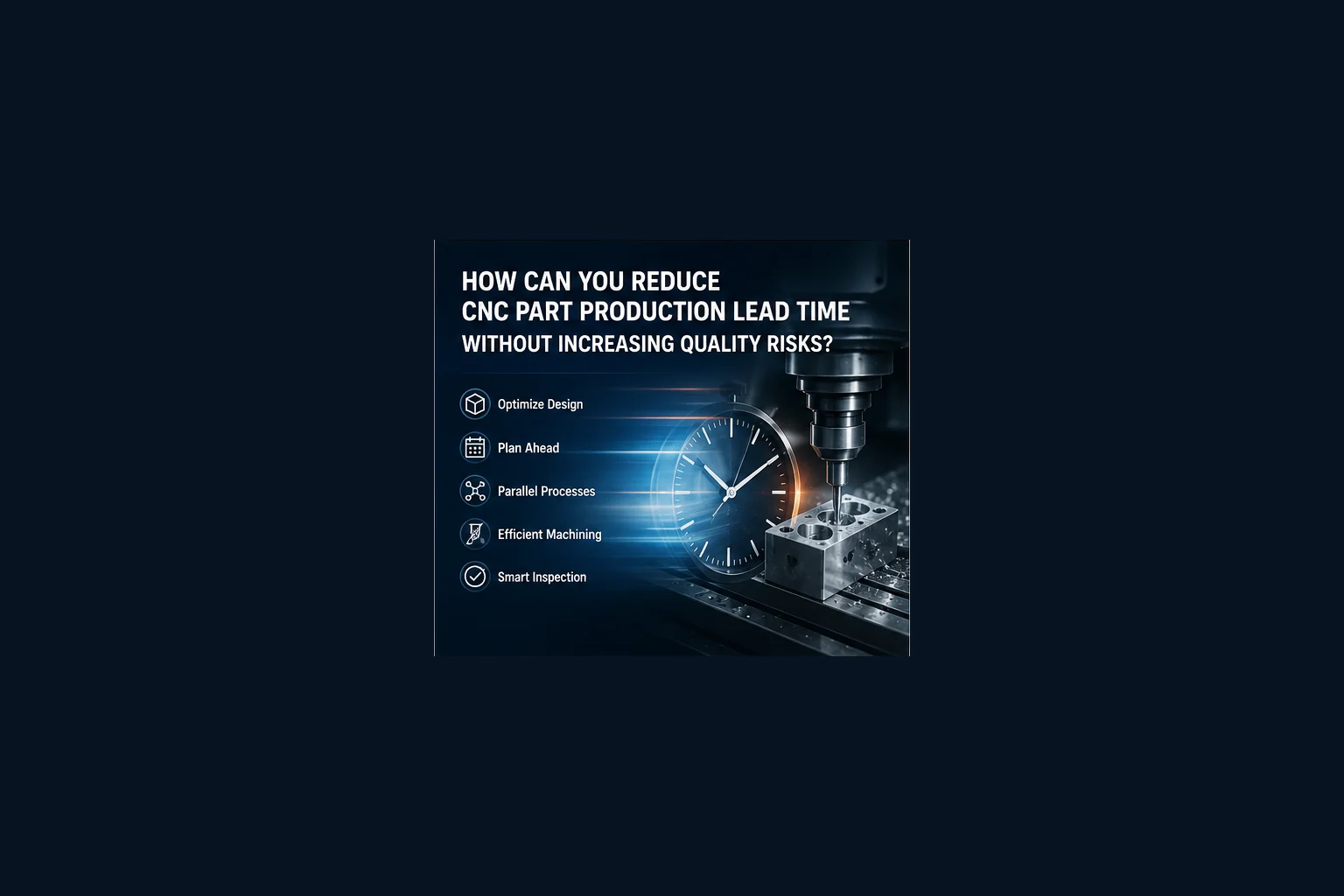
Reducing CNC production lead time does not require choosing between speed and quality. The greatest delays in a machining project often occur before or between cutting operations: incomplete drawings, material shortages, quotation revisions, supplier-capability mismatches, fixture preparation, waiting for inspection, surface-treatment queues, and late engineering changes.
A supplier can run a machine faster, skip inspections, or shorten finishing cycles, but these actions do not create a reliable lead-time improvement. They transfer time from the planned process into rework, sorting, replacement production, customer complaints, and emergency shipping. A rushed part that fails inspection is not an early delivery.
The safer approach is to remove non-value-adding waiting while preserving the controls that protect material identity, dimensions, surface condition, and function. This requires a complete plan covering design release, DFM review, material supply, capacity, machining sequence, tooling, inspection, special processes, packaging, and shipment.
This guide explains where CNC lead time comes from, which acceleration methods are low-risk, which shortcuts create quality problems, how engineering and procurement teams can prepare faster RFQs, and how RapidMFGPro helps match urgent projects with appropriate machining, finishing, and inspection resources.
What Actually Determines CNC Production Lead Time?
Quoted lead time is the total elapsed time from order release to shipment. Actual spindle cutting time may represent only a portion of that period.
Preproduction Time
Before machining begins, a project may require:
- Drawing and CAD review
- Material confirmation
- DFM questions and customer responses
- CAM programming
- Fixture design
- Tool procurement
- Material purchasing and cutting
- Quality-plan preparation
Incomplete information can stop several of these activities simultaneously.
Production and Queue Time
The manufacturing stage includes more than cutting:
- Waiting for the scheduled machine
- Setup and probing
- First-piece machining
- First-piece approval
- Batch machining
- Deburring and cleaning
- In-process inspection
- Transfer between operations
A part with a two-hour machining cycle may still spend several days waiting between departments.
External Process and Release Time
After machining, parts may require:
- Heat treatment
- Anodizing or plating
- Passivation or electropolishing
- Grinding or polishing
- Final inspection
- Documentation review
- Packaging and transport
Lead-time reduction must address the complete route rather than only machine speed.
| Lead-time element | Typical delay | Low-risk reduction method |
|---|---|---|
| Requirement review | Missing files, conflicting dimensions, unclear finish | Release one controlled RFQ package |
| Material supply | Nonstandard alloy or unavailable stock size | Confirm availability before design freeze |
| Programming | Complex geometry and repeated revisions | Complete DFM review before final CAM |
| Fixture preparation | No stable clamping or datum surfaces | Design accessible, repeatable workholding features |
| Machine queue | Part assigned to an unavailable process | Match the project to confirmed capacity |
| Inspection | CMM queue or unclear acceptance method | Prepare the inspection plan before machining |
| Surface treatment | Outside processor batch schedule | Reserve the finishing slot and clarify masking early |
| Release and shipping | Missing certificates or packaging decisions | Prepare documents and packaging requirements in parallel |
Map the Complete Value Stream Before Expediting
Teams often apply pressure to the visible machining operation while the true constraint is material, inspection, finishing, or approval.
Identify Processing Time and Waiting Time Separately
For every step, record:
- Actual processing time
- Queue time
- Transport time
- Approval time
- Rework probability
NIST describes value-stream mapping as a method for visualizing material and information flows and identifying opportunities to streamline processes and reduce lead times.
Find the Critical Path
The critical path is the sequence of dependent activities that determines the earliest possible completion date. Activities outside this path can sometimes be delayed without changing shipment, while one late critical activity delays the entire order.
Typical CNC critical-path items include:
- Long-lead certified material
- Custom fixtures
- Heat treatment before final machining
- Customer first-article approval
- A qualified special process
Remove the Constraint Instead of Accelerating Everything
If anodizing has a seven-day queue, increasing milling speed by ten percent may not change shipment. Lead-time reduction should focus on the limiting step.
Release a Complete and Controlled RFQ Package
The fastest project is usually the one that requires the fewest clarification loops.
Make the CAD Model and Drawing Agree
Confirm consistency in:
- Revision level
- Dimensions
- Hole and thread depths
- Material
- Surface treatment
- Quantity
- Inspection notes
When model and drawing information conflict, the supplier must stop or make a risky assumption.
Define the Critical Characteristics
Identify features that control:
- Assembly
- Sealing
- Bearing or shaft fits
- Optical alignment
- Pressure containment
- Safety
This helps the supplier plan machining and inspection effort around real risk rather than treating every dimension as equally critical.
State Commercial and Delivery Priorities Clearly
The RFQ should include:
- Required quantity
- Required delivery date
- Whether partial shipment is acceptable
- Prototype and future production volume
- Required certificates
- Destination and packaging needs
A vague request for “the fastest possible lead time” is less useful than a clear date and a list of negotiable requirements.
Complete DFM Review Before Final Production Release
Late design changes are among the most damaging lead-time risks because they can invalidate material, programs, fixtures, inspection data, and finished parts.
Review Tool Access and Setup Count
DFM review should identify:
- Features requiring extra orientations
- Deep pockets and small cutters
- Inaccessible undercuts
- Blind threads without chip clearance
- Thin walls that may distort
- Surfaces that cannot be measured easily
Resolve Tolerances Before Programming
A tolerance change after CAM and fixture preparation may require:
- A different tool
- A finishing operation
- A new inspection method
- A different supplier or machine
Relaxing a noncritical tolerance can shorten production, but it should be approved before work begins.
Freeze the Correct Revision
Production release should identify one controlled revision. If an urgent change is unavoidable, the team should state:
- Which parts or operations are affected
- Whether existing material remains usable
- Whether work in progress may continue
- What inspection or approval must be repeated
Choose Materials That Are Available and Appropriate
A design cannot enter machining until the correct material is available. Material lead time can exceed machining time, especially for certified, imported, or unusual alloys.
Check Stock Form and Size Before Release
Confirm availability of:
- Alloy and temper
- Plate, bar, tube, or forging form
- Required thickness or diameter
- Certification level
- Country-of-origin restrictions
- Minimum purchase quantity
Use Standard Stock When Function Permits
A small dimensional change may allow a common plate or bar size and remove days or weeks of procurement delay.
This should not override:
- Mechanical properties
- Grain direction
- Corrosion requirements
- Regulatory requirements
- Validated surface-treatment behavior
Approve Alternatives Through Engineering Control
Alternative material should never be substituted informally for speed. An approved alternative must satisfy defined chemistry, mechanical properties, heat treatment, certification, and finishing requirements.
| Material decision | Potential lead-time effect | Quality safeguard |
|---|---|---|
| Use common stock thickness | Faster sourcing and cutting | Confirm final geometry and workholding allowance |
| Use equivalent alloy | Avoid long procurement delay | Formal engineering approval and certification review |
| Use customer-supplied material | Can bypass supplier purchasing | Verify quantity, identity, condition, and traceability |
| Use near-net blank | Reduce roughing time | Validate blank tolerance, porosity, grain, and qualification |
| Purchase before final design freeze | Can shorten the critical path | Only when alloy and stock envelope are unlikely to change |
Match the Project to Confirmed Supplier Capacity
An urgent order should not be awarded only to the supplier offering the lowest nominal cycle time. Capacity, equipment, inspection, and finishing access must be available during the required window.
Verify the Required Machine Is Available
Confirm the actual need for:
- Three-axis milling
- Five-axis machining
- CNC turning or mill-turn
- Deep-hole drilling
- Grinding
- EDM
A less suitable machine can increase setups, handling, and alignment risk.
Confirm Inspection Capacity
A supplier may have machining capacity but no open CMM, contour measurement, thread-gauging, or surface-roughness capacity. The inspection queue should be confirmed with the production queue.
Confirm Special-Process Capacity
For anodizing, plating, passivation, heat treatment, or PVD coating, verify:
- Process compatibility with the material
- Required certification
- Available batch date
- Masking requirements
- Post-process inspection
RapidMFGPro’s supplier-matching role is especially relevant when machining and finishing capacity must be coordinated rather than sourced independently.
Reserve Long-Lead Resources Before Machining Begins
Some project activities can be initiated before the first chip is cut without compromising quality.
Reserve Machine and Finishing Slots
When the design and route are sufficiently stable, the supplier can schedule:
- Machine capacity
- CMM time
- Heat-treatment batches
- Coating or anodizing slots
- Packaging and collection
Order Special Tools and Gauges Early
Long-lead items can include:
- Custom form tools
- Special reamers
- Thread gauges
- Fixtures
- Master components
Ordering before final release is safe only when the relevant interface is unlikely to change.
Prepare Documentation in Parallel
Certificates, inspection templates, ballooned drawings, packaging labels, and shipping documents can be prepared while machining is underway.
Use Parallel Processing Without Creating Configuration Risk
Parallel work shortens elapsed time by overlapping independent activities. It becomes dangerous when dependent activities use unapproved or changing information.
Activities That Can Often Run in Parallel
- Material procurement and CAM preparation
- Fixture manufacture and inspection programming
- Packaging preparation and production
- Finishing-slot reservation and machining
- Certificate-template preparation and inspection planning
Activities That Should Not Be Started from Unstable Data
High-risk parallel activities include:
- Final fixture manufacture before datum approval
- Special gauge manufacture before tolerance freeze
- Production machining before material substitution approval
- Coating before dimensional acceptance
Use Clear Configuration Control
Every team and supplier should use the same revision. File names, transmittal records, purchase orders, and inspection plans should identify the controlled product definition.
Reduce Setup and Changeover Time Safely
Setup reduction improves lead time without changing part requirements.
Use Modular or Quick-Change Workholding
Options include:
- Zero-point pallets
- Standard fixture plates
- Prepared soft jaws
- Self-centering vises
- Preset fixture offsets
NIST reports that structured setup-reduction methods such as SMED can eliminate, move, simplify, or streamline setup activities. In one documented MEP project, equipment setup time on a part was reduced by more than 70%.
Preset Tools Outside the Machine
Tool presetting and quick-change holders can reduce:
- Manual measurement
- Test cuts
- Offset entry
- Machine idle time
Sandvik identifies quick-change tooling as a method for reducing measurement, setup, and tool-change time while maintaining accurate return to position.
Combine Operations When Capability Allows
Mill-turn or five-axis machines can reduce part transfers and datum changes. A more capable machine may have a higher hourly rate but a shorter and safer total route.
Optimize Cutting Time Without Exceeding Process Capability
Cycle time should be improved through stable tooling and cutting strategy, not by increasing feed and speed beyond the limits of the setup.
Use the Largest Rigid Tool That Fits the Geometry
Larger cutters generally support higher material-removal rates and lower deflection. Design changes such as larger internal radii and wider pockets can therefore shorten machining time.
Reduce Tool Overhang
Sandvik notes that machine rigidity, tool overhang, and fixturing stability determine what cutting conditions a process can support. Long overhangs require more conservative settings.
Use Stable Toolpaths and Coolant Delivery
Constant-engagement roughing, high-pressure coolant where appropriate, chip evacuation, and suitable tool materials can improve cycle time and tool life simultaneously.
Aggressive parameters that create unpredictable tool failure increase lead-time risk.
Move Quality Planning Upstream
Inspection should not begin after the complete batch is finished. Early quality planning prevents late discovery of systematic errors.
Create a Quality Plan Before Production
ISO 10005:2018 provides guidance for establishing quality plans for a product, project, process, or contract.
A CNC quality plan can define:
- Material verification
- First-piece checks
- In-process controls
- Final inspection
- Sampling
- Special-process verification
- Required records
Inspect High-Risk Features Early
Check critical dimensions after the operation that creates them, especially when later operations would make rework difficult.
Examples include:
- Datum surfaces
- Deep bores
- Threaded holes
- Thin-wall dimensions
- Features affected by heat treatment
Use First Article to Protect the Batch
First-article inspection verifies that the manufacturing process, documentation, and part characteristics agree before full production proceeds. SAE AS9102C, revised in June 2023, establishes requirements for performing and documenting aerospace first-article inspection.
Skipping first article may save hours and risk losing days or weeks.
Use Risk-Based Inspection Rather Than Removing Inspection
Lead time can be reduced by applying the correct inspection intensity, not by treating every feature identically or eliminating checks.
Use 100% Inspection for Critical or Unstable Features
This may include:
- Safety characteristics
- Leak-critical features
- Automated assembly interfaces
- New or unstable processes
- Features with severe failure consequences
Use Sampling for Stable, Lower-Risk Characteristics
ISO 2859-1:2026 provides sampling schemes indexed by acceptance quality limit for lot-by-lot inspection by attributes.
Sampling should be selected according to:
- Lot size
- Process history
- Failure severity
- Detection method
- Customer requirements
Use In-Process Gauging to Prevent End-of-Batch Surprises
Machine probing, tool measurement, bore gauges, thread gauges, and automated measurements can detect drift while correction is still possible.
| Quality approach | Lead-time effect | Risk level |
|---|---|---|
| Skip first article | May save initial hours | High risk of complete-batch rework |
| First article before full batch | Adds an approval gate | Reduces systematic production risk |
| Inspect every dimension on every part | Can create a large inspection queue | May be unnecessary for stable noncritical features |
| Risk-based control plan | Focuses time on important features | Low when properly justified |
| End-of-batch inspection only | Simple scheduling | Late discovery of drift or setup error |
| In-process inspection | Prevents continued production of defects | Low when measurement is reliable |
| Unapproved measurement shortcut | Appears faster | High risk of incorrect acceptance |
Plan Surface Treatments as Part of the Critical Path
Special processes frequently create the longest external queue and may also change dimensions.
Confirm the Process Before Machining Allowances Are Set
The machining supplier needs to know:
- Coating type
- Thickness
- Masking
- Final dimensional condition
- Required testing
Reserve Batch Dates Early
Qualified anodizing, plating, heat-treatment, passivation, electropolishing, or PVD resources may operate on fixed batch schedules. Slot reservation can shorten waiting without changing process time.
Do Not Shorten Chemical or Thermal Cycles Informally
Reducing treatment time or temperature outside the qualified process can cause:
- Insufficient coating thickness
- Poor adhesion
- Incorrect hardness
- Incomplete passivation
- Dimensional instability
Accelerate scheduling and logistics, not the validated process chemistry.
Use Partial Shipments and Production Splits Carefully
Partial delivery can meet the customer’s immediate need while the remaining quantity follows the normal process.
Ship Approved Priority Parts First
This is useful when:
- Only a small quantity is needed for assembly
- Customer testing can begin before the full batch
- The finishing process supports separate lots
- Inspection records can identify each shipment
Do Not Split Lots Without Traceability
Each partial lot should retain:
- Material traceability
- Revision identity
- Process records
- Inspection status
- Packaging identification
Review the Cost and Risk of Multiple Shipments
Splitting production can add:
- Repeated setup
- Separate inspection
- Additional finishing minimum charges
- More logistics
It is most effective when the priority quantity is clearly defined before production starts.
Control Engineering Changes During an Urgent Order
Urgent projects often attract late improvement requests. Without control, these changes can eliminate all lead-time gains.
Classify the Change
Determine whether it is:
- A safety or functional correction
- A cosmetic improvement
- A future-production optimization
- A documentation-only update
Assess Work-in-Progress Impact
Before approval, identify:
- Parts already machined
- Material already cut
- Programs and fixtures affected
- Inspection records requiring revision
- Delivery-date impact
Defer Noncritical Changes to the Next Revision
When safe and acceptable, ship the released design and apply noncritical improvements to the next batch. Mixing revisions during an urgent order increases configuration and traceability risk.
Which Lead-Time Shortcuts Create Quality Risk?
Some actions appear to save time but should be treated as formal risk decisions rather than routine acceleration methods.
Skipping Material Verification
Wrong material can pass dimensional inspection and fail in service. Preserve:
- Purchase records
- Mill certificates
- Material identification
- Lot separation
Skipping First Article or Critical Inspection
A setup, program, or interpretation error can be repeated across the complete batch.
Using an Unqualified Finish Supplier
An available processor may lack the required chemistry, alloy experience, documentation, or testing.
Overloading Machines or Operators
Excessive overtime can increase:
- Loading mistakes
- Inspection errors
- Tool-change mistakes
- Handling damage
- Documentation omissions
A Safe CNC Lead-Time Reduction Plan
A structured plan should compress elapsed time while retaining clear decision gates.
Before Purchase Order Release
- Complete DFM review
- Freeze revision
- Confirm material availability
- Define critical characteristics
- Confirm partial-shipment needs
- Match required capabilities and capacity
During Preproduction
- Run material, programming, fixture, and inspection planning in parallel
- Reserve machine, CMM, and finishing capacity
- Prepare quality and documentation templates
- Confirm packaging and logistics
During Production and Release
- Approve first article promptly
- Inspect critical features in process
- Track the critical path daily
- Escalate deviations immediately
- Release approved partial lots when useful
How Does RapidMFGPro Support Short-Lead-Time CNC Projects?
RapidMFGPro operates as a manufacturing resource and supplier-matching platform. Short lead time depends on matching the full project route rather than finding any available machine.
Reviewing Requirements Before Supplier Matching
The project review can identify:
- Missing or conflicting information
- Long-lead material
- Features requiring specialized machines
- Critical inspection and documentation
- Surface-treatment dependencies
- Opportunities for partial delivery
Matching Capacity Across the Complete Route
Supplier matching may need to coordinate:
- CNC milling or turning
- Grinding or EDM
- Heat treatment
- Surface finishing
- CMM or functional inspection
- Packaging and shipment
An available machining supplier is not enough if the required finishing or inspection capacity is unavailable.
Protecting Quality During Acceleration
The accelerated plan can retain:
- Material traceability
- Controlled revisions
- First-article approval
- Risk-based inspection
- Special-process verification
- Final documentation
The objective is to shorten queues, handoffs, and avoidable setup rather than remove the controls that prevent failure.
Frequently Asked Questions
What Is the Fastest Way to Reduce CNC Lead Time?
Release complete data, confirm material and capacity early, complete DFM before programming, and reserve machining, inspection, and finishing slots on the critical path.
Can CNC Parts Be Produced Faster by Skipping First Article Inspection?
It may shorten the first step, but it increases the risk that a setup or interpretation error affects the complete batch. First article normally protects total lead time.
Does Paying an Expedite Fee Guarantee Faster Delivery?
No. An expedite fee may secure priority, overtime, or dedicated coordination, but it cannot eliminate unavailable material, required process time, customer approval, or qualified finishing constraints.
Should Inspection Be Reduced for an Urgent Order?
Inspection can be optimized through risk-based planning and in-process checks. Critical, safety, or unstable features should not lose required control.
Can Material Be Purchased Before the Design Is Frozen?
Yes, when alloy, certification, and stock envelope are stable. The buyer should understand the risk that a design change makes the material unusable.
Can Partial Shipment Reduce Lead Time?
It can provide usable parts earlier when priority quantity, lot traceability, inspection, finishing, and packaging are planned before production.
Is a More Expensive Five-Axis Machine Faster Overall?
It can be when it reduces setups, fixture changes, and datum transfer. The correct comparison is total route time and risk, not hourly machine rate alone.
What Information Should Be Provided for an Urgent CNC Quote?
Provide controlled CAD and drawings, material, quantity, critical tolerances, finish, inspection requirements, delivery date, acceptable partial quantity, certifications, and destination.
Reference Sources
- NIST MEP — Value Stream Mapping
- NIST MEP — Lean and Process Improvement
- NIST MEP — Setup-Time Reduction Case Study
- ISO 10005:2018 — Guidelines for Quality Plans
- ISO 2859-1:2026 — Sampling Procedures for Inspection by Attributes
- ISO 9001:2015 with Amendment 1:2024 — Quality Management Systems
- SAE AS9102C — Aerospace First Article Inspection Requirements
- Sandvik Coromant — Quick-Change Tooling for Turning Centers
- Sandvik Coromant — Building Efficiency into Metal Cutting
- Sandvik Coromant — Multi-Task Machine Tooling
Conclusion
CNC lead time should be reduced by eliminating incomplete information, waiting, unnecessary setups, poorly matched capacity, and late discovery of defects. Complete DFM review, material confirmation, parallel preparation, quick-change tooling, early first-article approval, in-process inspection, and reserved finishing capacity can shorten delivery without weakening control.
Do not accelerate by skipping traceability, critical inspection, or validated surface-treatment cycles. These shortcuts create rework and replacement risk.
RapidMFGPro helps review the full critical path and match urgent projects with appropriate machining, finishing, inspection, and delivery resources.
Need Help Reviewing a Custom Part?
Share your CAD file and requirements to request supplier matching. Supplier capability and commercial terms must be verified before order placement.
Request Supplier Match