Time to read: 22 min
How to Find a Reliable CNC Parts Manufacturer: A Buyer’s Guide
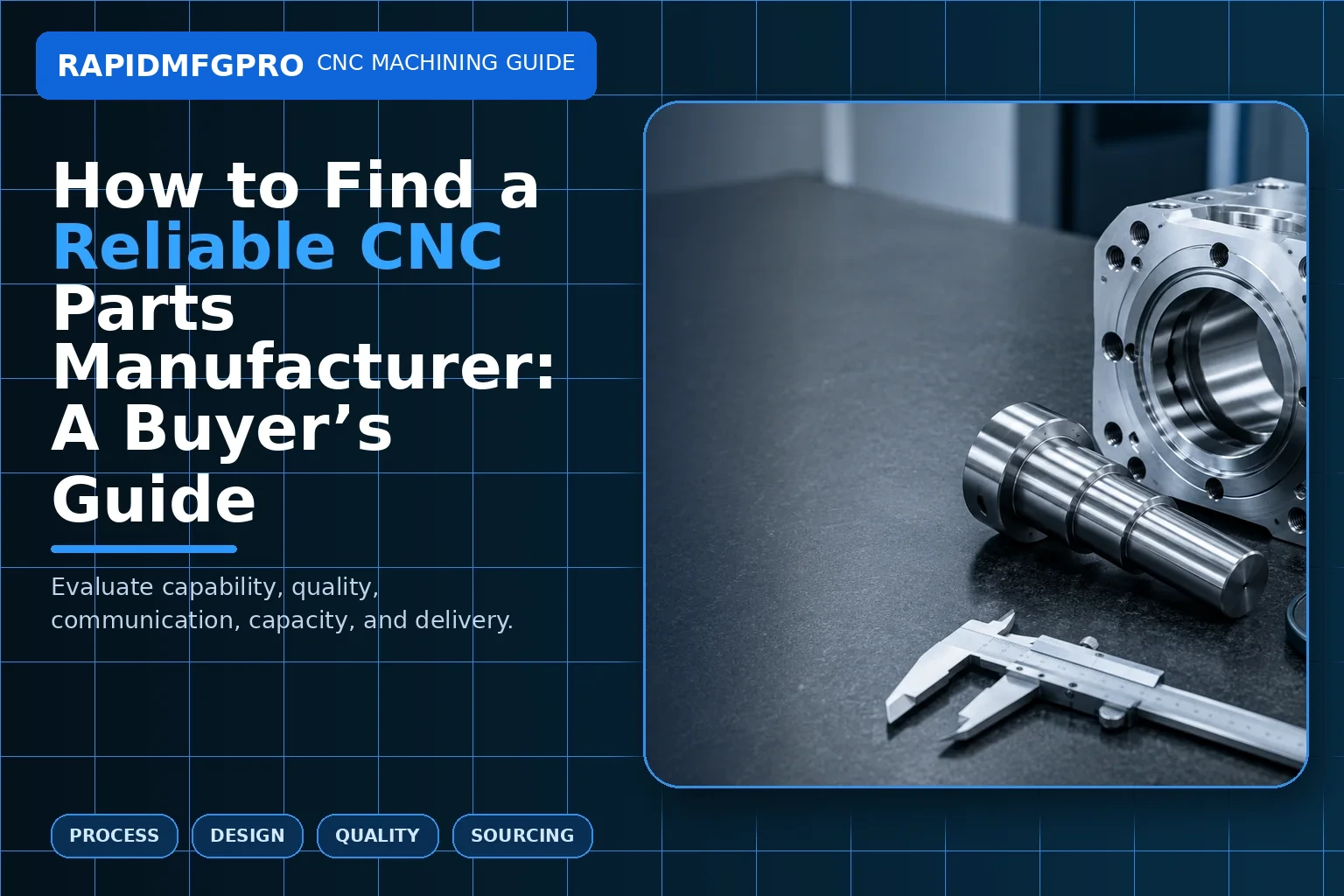
Direct answer: A reliable CNC-parts manufacturer is not simply the supplier with the lowest quote or the largest machine list. It is a manufacturer whose equipment, process experience, quality controls, capacity, communication, and commercial terms fit your specific part. To find one efficiently, prepare a complete RFQ, screen suppliers by relevant capability, request a manufacturability response, compare complete process routes, validate a first article, and confirm how repeat orders and nonconformances will be controlled.
The search becomes difficult when buyers send incomplete drawings to many suppliers and compare only unit prices. Different suppliers may quote different materials, tolerances, finishes, inspection scopes, or assumptions. The prices are not truly comparable. This guide explains a structured sourcing method and shows how RapidMfgPro supports buyers by identifying independent suppliers for evaluation rather than claiming to manufacture every project itself.
What Makes a CNC Manufacturer Reliable?
Reliability means consistent delivery against an agreed requirement
A reliable supplier produces parts that match the controlled drawing, material, quantity, finish, inspection scope, and delivery commitment. Consistency matters more than a single good sample. The supplier must control revisions, material identity, programs, fixtures, tools, inspection equipment, outside processes, packaging, and shipment.
Reliability is project-specific. A shop excellent at high-volume small brass components may be unsuitable for large 5-axis titanium housings. A prototype specialist may communicate quickly but lack the fixtures and process controls for recurring production. A regulated medical or aerospace project may require documentation that a general industrial shop does not maintain.
Capability is a combination of machines, people, and systems
Machine brand and axis count are visible, but they do not show the full process. Experienced programmers, machinists, fixture designers, inspectors, and project managers are essential. The supplier must know how to machine the material, hold the geometry, prevent distortion, deburr hidden features, and inspect the correct datums.
Quality systems provide a framework for document control, calibration, training, nonconformance, and corrective action. Certification can be useful evidence, but certification alone does not prove that the supplier has produced a similar part successfully.
| Reliability factor | What to verify | Useful evidence | Warning sign |
|---|---|---|---|
| Technical fit | Machine envelope, axes, materials, tolerances | Process explanation and relevant examples | Generic “we can make anything” response |
| Quality control | Inspection equipment, calibration, FAI, traceability | Sample report and quality procedure | No defined final-inspection responsibility |
| Capacity | Lead time, shift pattern, bottlenecks, outside processes | Realistic schedule and capacity discussion | Unusually short promise without process detail |
| Communication | DFM questions, revision acknowledgement, response time | Clear written assumptions and action list | Quote issued despite missing critical information |
| Commercial stability | Payment, warranty, nonconformance, repeat pricing | Formal quotation and terms | Important commitments only made verbally |
How Should You Prepare before Searching?
Define the part and the business requirement
Prepare the STEP model, controlled PDF drawing, exact material grade, quantity, expected annual volume, finish, heat treatment, target date, destination, inspection scope, and required documents. Identify whether the project is a prototype, replacement part, bridge-production batch, or recurring production program.
Explain the application without disclosing unnecessary confidential information. A supplier benefits from knowing whether a bore holds a bearing, a face seals fluid, a housing aligns optics, or a bracket is cosmetic. Functional context helps the supplier prioritize risks and propose sensible DFM changes.
Separate mandatory requirements from preferences. If the material cannot change, mark it mandatory. If finish color can vary slightly, say so. If delivery is more important than unit cost, the sourcing strategy may favor available capacity over long-term production optimization.
Use revision-controlled files and a question log
Assign a part number and revision to every RFQ. Do not email multiple unlabeled drawings. When a supplier asks a question, record the answer and distribute it to every bidder so quotes remain comparable.
List assumptions that suppliers must confirm: raw-stock form, tolerance standard, deburring, cosmetic class, inspection sampling, packaging, and whether outside processing is included. A quote that omits these items may appear cheaper but create later change orders.
Where Can You Find CNC Manufacturers?
Direct search, referrals, directories, and sourcing platforms each have strengths
Direct web search can identify local or specialized manufacturers, but website claims require verification. Industry referrals can be valuable because they include experience, yet a supplier that fits one company’s part may not fit yours. Trade associations and manufacturing directories provide broad lists but often lack project-specific screening.
Online manufacturing platforms may offer instant quoting, managed production, or supplier matching. These models are different. Buyers should understand who contracts for the work, who holds quality responsibility, whether the manufacturing source is disclosed, and how files are shared.
RapidMfgPro is positioned as a supplier-matching resource. It reviews project information and helps identify independent suppliers that may fit the requirement. The buyer evaluates and approves the resulting manufacturing option.
Start with a short qualified list, not hundreds of contacts
Sending an RFQ to too many unqualified shops wastes time and increases confidentiality exposure. Build a short list based on part size, process, material, tolerance, quantity, industry documentation, location, and lead time.
Three to five serious quotations often provide better insight than dozens of automated prices. A qualified supplier should be willing to discuss the route and assumptions before final award.
| Sourcing channel | Strength | Limitation | Best use |
|---|---|---|---|
| Direct manufacturer search | Direct technical relationship | Buyer performs all screening | Known process and local market |
| Industry referral | Practical performance feedback | May not match your geometry or volume | Similar parts and quality expectations |
| Trade directory | Broad supplier discovery | Profiles may be outdated or generic | Initial market mapping |
| Instant-quote platform | Fast price and manufacturability feedback | Routing and quality model may vary | Standard prototype work |
| Supplier-matching platform | Project-specific search and comparison support | Buyer still qualifies and approves supplier | Custom requirements needing targeted capability |
How Do You Verify Technical Capability?
Match machine limits to the actual part
Confirm maximum travel, table load, spindle capability, chuck diameter, bar capacity, axis count, and tool access. A machine may physically fit a part but leave no practical room for fixtures or tool holders. Large-part machining also requires lifting, probing, and temperature control.
Ask whether the proposed route uses 3-axis, 4-axis, 5-axis, turning, mill-turn, grinding, EDM, or multiple machines. The supplier should explain setup count and how critical datums transfer. A machine list without a route does not prove capability.
Verify material and feature experience
A supplier experienced with aluminum prototypes may not understand thin-wall titanium, hardened tool steel, copper thermal components, or PEEK medical fixtures. Material behavior affects tools, coolant, distortion, cleaning, and inspection.
Ask about features similar to yours: deep bores, sealing grooves, optical datums, thin walls, long shafts, precision threads, internal channels, cosmetic surfaces, or large flatness. The supplier can protect customer confidentiality while still describing process experience.
How Do You Evaluate Quality Systems and Inspection?
Confirm that the inspection method fits the tolerance
Calipers are appropriate for some dimensions but not for every tolerance. Bearing bores may need bore gauges or air gauges. Complex position and profile may need a CMM. Surface roughness needs a roughness tester. Threads need calibrated gauges. Hidden passages may need borescopes, flow tests, or cleaning verification.
Ask who creates the inspection plan and who approves the final report. For a first article, request a sample report before ordering. Check that the report references the drawing revision and identifies instruments or methods where necessary.
Review document control and nonconformance handling
The supplier should control drawing revisions, material certificates, outside-process certificates, inspection records, and calibration. For recurring orders, confirm retention time and traceability level.
Ask what happens when a part fails inspection. A reliable process includes segregation, notification, root-cause analysis, disposition approval, rework control, and corrective action when needed. A supplier that quietly ships deviations is not reliable even if most parts are good.
| Quality question | Strong answer | Weak answer | Why it matters |
|---|---|---|---|
| How are critical dimensions identified? | Ballooned drawing and inspection plan | “Inspector checks everything” | Ensures consistent scope |
| How are gauges controlled? | Calibration system with status and recall | Tools are checked when they look wrong | Measurement evidence must be trustworthy |
| How are revisions controlled? | Released files linked to job traveler/program | Latest email attachment is used | Prevents mixed-revision production |
| How are defects handled? | Documented NCR, containment, disposition, corrective action | Parts are remade without record | Shows learning and traceability |
| Who controls outside processes? | Approved processors and certificate review | Coating is sent to whoever is available | Secondary operations can change dimensions and quality |
How Should You Compare CNC Quotations?
Normalize scope before comparing price
Check material grade and stock form, quantity, tolerance assumptions, surface finish, deburring, heat treatment, coating, marking, cleaning, inspection, certificates, packaging, shipping terms, tooling charges, taxes, and lead time. A price without these details is not a complete comparison.
Confirm whether the quote includes first article, sample inspection, or 100% inspection. Ask whether nonrecurring engineering and fixtures are separate. For repeat orders, identify the valid price period and minimum batch.
Evaluate the proposed process and risk
A higher quote may use fewer setups, better stock, dedicated fixtures, or complete inspection. A lower quote may depend on manual rework or omit secondary operations. Ask suppliers to describe the route at an appropriate level.
Use a weighted score rather than price alone. Technical fit, quality, delivery, communication, commercial terms, and scalability can be scored according to project risk.
| Evaluation category | Example weight for a critical project | Questions | Evidence |
|---|---|---|---|
| Technical capability | 25% | Can the proposed route hold the critical geometry? | DFM response and process plan |
| Quality and documentation | 25% | How will requirements be inspected and recorded? | Sample FAI, certificates, quality procedures |
| Delivery and capacity | 20% | Is the schedule realistic and repeatable? | Capacity discussion and milestone plan |
| Communication | 15% | Are questions, assumptions, and revisions controlled? | RFQ response quality |
| Commercial value | 15% | Is total landed cost competitive for the scope? | Complete quotation and terms |
How Can Samples and Pilot Orders Reduce Risk?
Use a first article to validate both the part and the process
A first article is not only a sample to see whether the supplier can make one good part. It validates material, setup, tooling, inspection method, finish, packaging, and documentation. The first article should be made with the intended production process whenever practical.
Review the dimensional report, certificates, visual condition, assembly fit, and functional test. If the buyer changes the design after approval, identify which characteristics need revalidation.
Scale in controlled steps
After first-article approval, use a pilot batch to evaluate repeatability and delivery. Then increase volume. This staged approach is especially useful for complex new suppliers, critical parts, and products with evolving demand.
Do not place a large order only because the sample is acceptable. Confirm that fixtures, tool-life control, inspection frequency, and material supply can support the larger quantity.
What Red Flags Should You Avoid?
Commercial and technical red flags
- A firm quote is issued without reviewing missing material, tolerance, or finish data.
- The supplier promises every process internally but cannot explain equipment or partners.
- Lead time is dramatically shorter than all alternatives with no capacity explanation.
- The quotation does not identify exclusions, tooling, inspection, or shipping terms.
- The supplier refuses to acknowledge drawing revision or written clarifications.
- Material certificates or inspection reports are offered only after a problem occurs.
Communication red flags often predict production problems
Slow responses are not always a problem, but inconsistent, contradictory, or undocumented responses are. If the supplier cannot manage an RFQ question log, it may also struggle with revisions and nonconformance.
Overconfidence is another warning. Complex parts have risks. A reliable supplier identifies them and proposes controls rather than insisting there are no concerns.
How Does RapidMfgPro Make the Search Easier?
RapidMfgPro structures the supplier-matching request
Buyers can submit CAD files, drawings, material, quantity, finish, target date, inspection, and application notes. RapidMfgPro reviews the package for completeness and uses the requirements to identify independent suppliers that may fit the process, size, material, volume, and quality needs.
The platform can help reduce random outreach and expose missing information before quotation. It can also support a more consistent comparison by clarifying assumptions and supplier scope.
The buyer still approves the manufacturer
RapidMfgPro does not replace supplier qualification or engineering approval. The selected independent supplier is responsible for manufacturing under the agreed terms. The buyer should review the quotation, capability evidence, sample, inspection, certificates, commercial conditions, and confidentiality arrangement.
This transparent role is important: RapidMfgPro helps connect and organize; it should not imply ownership of factories or certifications that belong to third-party manufacturers.
How Can You Conduct a Remote CNC Supplier Audit?
Review documents, process evidence, and live operations
When an on-site audit is not practical, request a structured remote review. Ask for the quality certificate scope, organization chart, machine and inspection list, calibration procedure, sample traveler, first-article report, nonconformance form, outside-processor control, and photographs or live video of relevant equipment.
A remote tour should focus on the process proposed for your part. Confirm raw-material identification, program control, tool storage, fixture condition, in-process inspection, final inspection, nonconforming-material segregation, and packaging. A polished general company video is not a substitute for evidence tied to the project.
Use a checklist and record open actions. Sensitive customer parts can be hidden; the supplier can demonstrate the system without violating confidentiality.
Validate claims through a sample and reference data
Ask the supplier to explain a similar process challenge, the control used, and the inspection result. Relevant sample reports are more valuable than unrelated marketing photos. For high-risk projects, request material certificates, gauge examples, or process capability data from a comparable feature.
A remote audit does not guarantee performance, but it identifies gaps before award. Combine it with a first article, pilot batch, and clear purchase terms.
How Should You Protect Intellectual Property and Supply Continuity?
Control file sharing and confidentiality
Share only the information necessary for quotation and manufacturing. Use a confidentiality agreement where appropriate. Mark drawings with part number, revision, and proprietary status. Avoid sending uncontrolled archives that include unrelated designs or customer information.
When using a sourcing platform, understand who receives the files and obtain consent before project information is shared with third-party suppliers. RapidMfgPro’s supplier-matching workflow should make this role transparent. The buyer should approve the suppliers that receive sensitive production data.
Plan for repeat orders, backups, and ownership of tooling
Confirm who owns custom fixtures, soft jaws, gauges, and programs, how long they are retained, and what happens if the relationship ends. For critical recurring parts, consider a second qualified source or at least a documented transfer plan.
Supply continuity also depends on material availability, outside processors, and key personnel. Ask whether the supplier has alternatives for heat treatment, coating, or grinding. A low price from a single fragile route can create higher long-term risk.
How Should Performance Be Managed after Supplier Approval?
Track quality, delivery, communication, and commercial stability
Use a simple scorecard that records on-time delivery, accepted quantity, nonconformance rate, corrective-action response, quotation accuracy, and communication. Review trends rather than judging one isolated incident. A supplier that reports a problem early and contains it responsibly may be more reliable than one that hides issues until delivery.
For recurring production, schedule periodic reviews of capacity, process changes, material sources, and outside processors. Require notification before significant changes that could affect form, fit, function, or documentation.
Use corrective action to improve the relationship
When a defect occurs, separate immediate containment from root-cause correction. Confirm affected lots, replacement timing, and buyer impact. Then evaluate whether the cause involved design ambiguity, supplier process, material, measurement, or communication.
A strong manufacturer provides evidence that the corrective action worked. RapidMfgPro can support communication and supplier comparison, but the technical disposition and contractual responsibility remain between the buyer and selected manufacturer.
What Should Be on the Final Supplier-Award Checklist?
Confirm technical and quality alignment before issuing the order
- Correct drawing and model revision are acknowledged.
- Material, condition, finish, heat treatment, and certificates are included.
- The proposed machine route and number of setups are understood.
- Critical dimensions, datums, inspection methods, and report scope are agreed.
- Outside processors and final-inspection responsibility are identified.
- First-article, pilot-batch, and production quantities are defined.
Any open DFM question should be resolved in writing. If the supplier proposes a deviation, the buyer should approve a revised drawing or formal concession before production.
Confirm commercial, logistics, and relationship terms
Review price validity, tooling ownership, payment, shipping terms, packaging, warranty, nonconformance response, confidentiality, data retention, and repeat-order conditions. Confirm the promised delivery date is based on material availability and outside-process capacity.
For critical recurring parts, define change-notification requirements and backup planning. RapidMfgPro can support the comparison and introduction, but the buyer should issue the final award only after technical, quality, and commercial terms are aligned with the independent manufacturer.
Before award, confirm the supplier understands the expected decision speed for technical questions. A delayed clarification can stop material purchasing or machine scheduling. Establish named engineering and commercial contacts, an escalation route, and the preferred format for revision notices. For overseas supply, account for time zones, holidays, customs documentation, and the time needed to replace a rejected shipment. These operational details often determine whether a nominally capable manufacturer is dependable in practice.
Keep an approved-supplier file containing the quotation, capability evidence, audit notes, sample results, certificates, contacts, and scorecard history. This prevents the organization from repeating the same qualification work and helps new team members understand why the source was selected.
Finally, document the reasons for supplier selection. A brief decision record covering technical fit, quality evidence, delivery, price, and identified risks improves accountability and makes future resourcing or dual-sourcing decisions faster.
This record should be reviewed whenever the process, volume, or application risk changes.
A clear award record also helps engineering, purchasing, and quality teams apply the same expectations during production.
It creates a practical baseline for future supplier reviews, repeat quotations, and corrective actions.
Conclusion
A reliable CNC-parts manufacturer is one whose complete process fits your geometry, material, tolerance, volume, documentation, and delivery risk. Prepare a controlled RFQ, qualify a short list, verify relevant capability, normalize quotation scope, and validate the first article before scaling. RapidMfgPro can make the search more efficient by reviewing the project package and identifying independent suppliers for evaluation, while the buyer retains technical approval and commercial control.
Need Help Reviewing a Custom Part?
Share your CAD file and requirements to request supplier matching. Supplier capability and commercial terms must be verified before order placement.
Request Supplier Match