Time to read: 8 min
Low-Volume vs Mass Production: Which Production Strategy Is Better for CNC Parts?
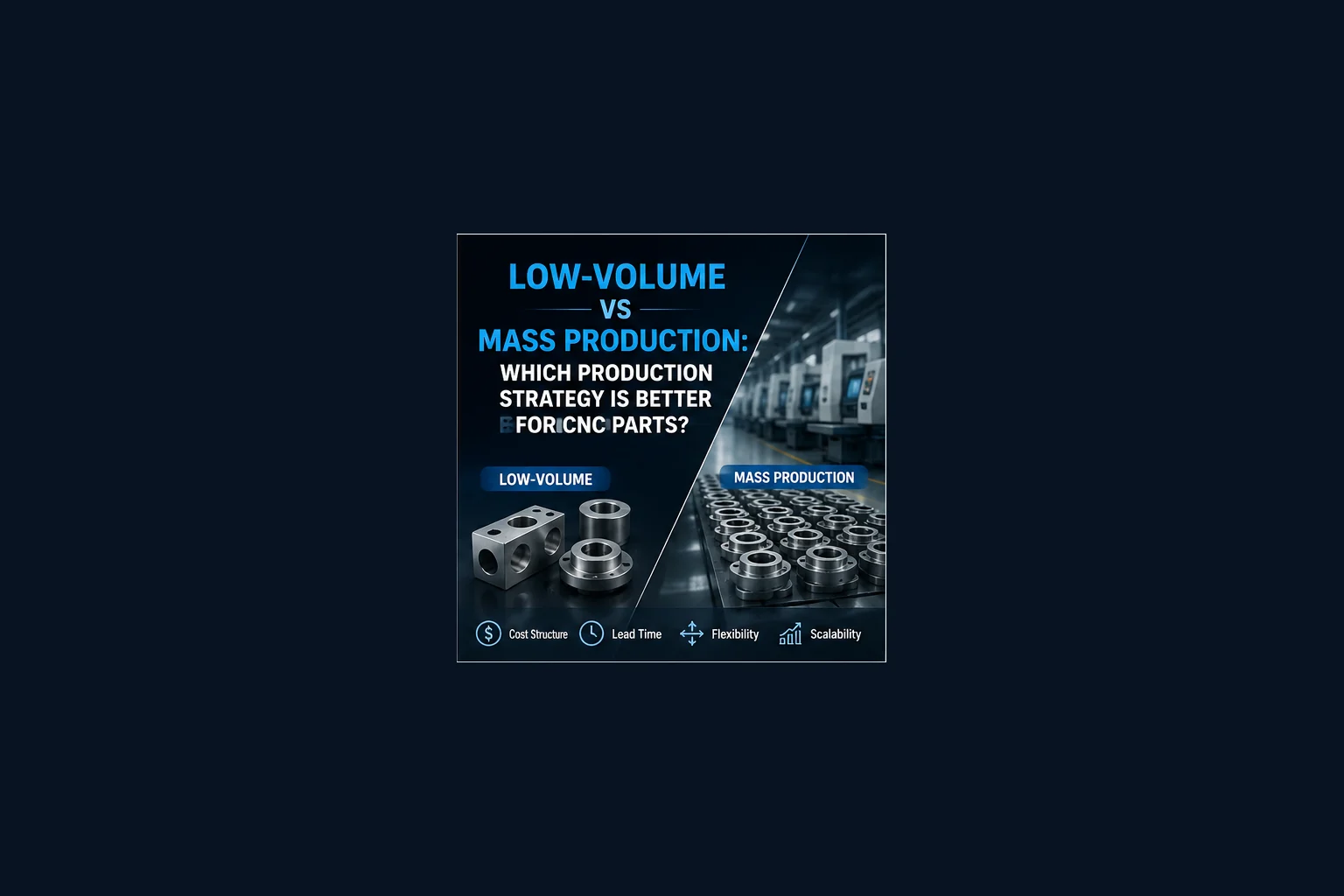
Choosing between low-volume and mass production for CNC parts is not simply a matter of comparing an order for 100 pieces with an order for 10,000 pieces. The better strategy depends on how stable the design is, how predictable demand is, how much production investment is required, and what happens if the forecast is wrong.
CNC machining is naturally suited to flexible production because parts can be manufactured directly from digital models and standard material without a mold or die. This makes it possible to move from prototypes to pilot batches and recurring orders without changing the fundamental process. However, the same CNC part may be produced very differently once demand becomes stable.
A low-volume batch may use standard vises, soft jaws, flexible tooling, operator loading, and detailed first-article inspection. A mass-production system may use dedicated fixtures, bar feeders, robots, tool-life monitoring, in-process gauging, automated washing, and statistical process control. The second route can achieve a lower unit cost, but only after the required investment, process validation, and capacity commitment have been justified.
The decision should therefore be made through a series of engineering and commercial gates. Is the design mature enough to freeze? Is annual demand real or only forecast? Is the current CNC process repeatable? Can dedicated equipment be paid back before the product changes? Would a casting, forging, extrusion, stamping, or molding route eventually replace full machining?
This guide explains how to answer these questions, how unit economics change with volume, how low-volume and mass-production CNC systems differ, what should trigger a production transition, and how RapidMFGPro supports supplier matching across prototype, bridge, and repeat-production stages.
Begin with the Demand Pattern, Not the Order Quantity
One purchase order does not always reveal the true production requirement. A one-time order for 5,000 parts is different from a monthly release of 500 parts for five years, even though the first order is larger.
One-Time Demand
A one-time project usually favors flexible tooling and limited capital investment. Examples include:
- Special equipment builds
- Research programs
- Facility upgrades
- Service-part replacements
- Short product campaigns
Dedicated fixtures may still be worthwhile if the part is complex, but the complete investment must be recovered within one production event.
Recurring Demand
Recurring releases provide stronger justification for production tooling because setup and loading savings repeat over time. The supplier can also plan material, machines, tools, labor, and finishing capacity more effectively.
Important questions include:
- How many releases are expected each year?
- What is the committed quantity versus forecast quantity?
- How much notice is provided before each release?
- Will the part remain unchanged?
High-Mix Demand
A customer may order a large total quantity divided among many part numbers and revisions. This is a high-mix environment rather than classic mass production.
NIST has described digital manufacturing and flexible automation as especially relevant to high-mix, low-volume environments, where product variation from batch to batch requires rapid reconfiguration rather than one dedicated line.
| Demand pattern | Typical strategy | Main reason |
|---|---|---|
| One-time small order | Flexible low-volume CNC | Avoid tooling that cannot be reused |
| One-time large order | Temporary production optimization | Recover setup improvements within one run |
| Monthly recurring release | Dedicated or semi-dedicated CNC system | Savings repeat across releases |
| Large total volume across many variants | High-mix flexible manufacturing | Frequent changeover remains necessary |
| Service parts with unpredictable demand | Digital inventory and low-volume production | Reduces obsolete finished stock |
| Stable long-life product | Mass-production review | Dedicated investment has time to pay back |
Decision Gate 1: Is the Product Design Mature?
Production investment should follow design maturity. A process optimized around an unstable drawing can become obsolete before it generates savings.
Prototype Designs Should Remain Easy to Change
During early development, teams may still modify:
- Hole locations
- Interfaces
- Wall thicknesses
- Materials
- Tolerances
- Surface treatments
Standard stock, modular fixtures, and editable CNC programs make these changes easier to absorb.
Pilot Batches Test Repeatability
A successful prototype proves that one part can work. A pilot batch must show that the same result can be achieved repeatedly.
Pilot production should confirm:
- Tool life
- Fixture repeatability
- Machining variation
- Finishing consistency
- Inspection time
- Packaging and delivery flow
Mass Production Requires Controlled Change
Once dedicated fixtures, gauges, automation, and near-net blanks are introduced, a small design revision can create substantial rework.
Before committing, the team should define:
- The released drawing revision
- Who approves changes
- How old inventory is handled
- Whether tooling must be modified
- Whether the process requires requalification
Decision Gate 2: Can the Process Produce Consistent Parts?
A mass-production strategy should not be built around a machining process that still relies on repeated manual adjustment or sorting.
Measure the Current Process Before Automating It
Useful baseline data include:
- Setup time
- Cycle time
- Tool life
- Scrap and rework rate
- Critical-dimension variation
- Inspection time
- Machine downtime
These measurements show where production investment can create a real return.
Separate Common-Cause Variation from Special Problems
Control charts can help distinguish the natural variation of a stable process from unusual events such as tool breakage, incorrect loading, coolant failure, or wrong material.
ISO 7870-2:2023 provides guidance on the use and understanding of Shewhart control charts for statistical control of a process.
Do Not Replace Capability with Final Sorting
Inspecting every finished part may detect some defects, but it does not create a stable process. Mass production should control:
- Blank location
- Tool condition
- Offsets
- Clamping force
- Temperature
- Measurement response
Automation can then maintain a controlled process rather than reproduce variation faster.
Decision Gate 3: Does the Investment Pay Back?
Production tooling is economically justified only when the expected savings exceed its complete cost.
Separate Fixed and Variable Costs
Fixed or one-time costs may include:
- CAM development
- Fixture design
- Fixture manufacturing
- Robot integration
- Special gauges
- Process qualification
Variable costs include material, machine time, tool consumption, labor, inspection, finishing, and packaging for each part.
Calculate Break-Even Quantity
Consider two possible routes:
- Flexible route: low startup cost and higher unit cost
- Production route: high startup cost and lower unit cost
The break-even quantity is the point where the accumulated savings from the lower production unit cost equal the additional upfront investment.
Break-even quantity = additional fixed investment ÷ unit-cost saving.
This simple model should be adjusted for maintenance, financing, qualification, design-change risk, and unused capacity.
Use Committed Demand, Not the Most Optimistic Forecast
An attractive forecast does not guarantee that tooling will be paid back. Review several scenarios:
- Minimum committed demand
- Expected demand
- High-demand forecast
- Early product cancellation
The strategy should remain financially acceptable under a realistic downside case.
| Investment | Potential unit-cost benefit | Risk if demand falls |
|---|---|---|
| Dedicated soft jaws | Faster loading and repeatable location | Relatively low |
| Multi-part fixture | More spindle time per loading cycle | Moderate |
| Special combination tool | Fewer tool changes and operations | Moderate |
| Robot loading cell | Higher utilization and lower direct labor | High if part family changes |
| Forging or casting tool | Lower material removal and faster machining | High tooling and minimum-order exposure |
| Dedicated automatic gauge | Faster high-frequency inspection | High if dimensions or part geometry change |
Decision Gate 4: Is CNC Still the Best High-Volume Process?
CNC machining can support mass production, but increasing volume should trigger a process comparison.
When Full CNC Machining Remains Competitive
CNC may remain the best route when the part requires:
- Wrought material properties
- Tight tolerances
- Complex variants
- Low porosity
- Frequent engineering changes
- Post-heat-treatment accuracy
Automated turning and milling systems can achieve very high output for suitable geometries.
When a Near-Net Blank Becomes Attractive
A forging, extrusion, casting, or preformed blank may reduce:
- Purchased material
- Chip volume
- Roughing time
- Machine power consumption
- Tool wear
CNC machining can then finish datums, holes, sealing faces, threads, and other critical features.
When Another Process Should Replace CNC
Very stable high-volume products may transition to:
- Die casting
- Metal injection molding
- Cold forming
- Stamping
- Plastic injection molding
- Dedicated transfer machining
The comparison must include tooling, material properties, finishing, secondary machining, quality risk, and the cost of future changes.
How Does Low-Volume CNC Production Operate?
A well-designed low-volume system is not an inefficient version of mass production. It is optimized for speed of change and low commitment.
Flexible Workholding
Low-volume suppliers commonly use:
- Standard vises
- Soft jaws
- Modular fixture plates
- Zero-point systems
- Five-axis self-centering vises
These systems can be reconfigured for different part numbers and revisions.
General-Purpose Tooling
Standard drills, end mills, taps, boring tools, and indexable cutters minimize special-tool lead time. Cycle time may be longer, but the supplier can launch production quickly.
Detailed First-Piece Verification
Low-volume batches often rely on:
- Complete first-piece inspection
- Material certification
- Functional assembly checks
- Customer approval before batch completion
The purpose is to identify design or interpretation problems before the limited batch is completed.
How Does Mass-Production CNC Operate?
Mass-production machining is organized around repeatability, utilization, and controlled response to variation.
Dedicated Production Cells
A production cell may combine:
- Bar or blank feeding
- Robotic loading
- CNC machining
- Deburring
- Washing
- Inspection
- Part marking
Sandvik describes multiple sister tools and automatic tool-change strategies as methods that can support continuous and unmanned machining.
Optimized Tool and Fixture Packages
Production engineering may use:
- Multi-part fixtures
- Hydraulic clamping
- Combination tools
- Special insert geometries
- Preset tool assemblies
- Automatic offset control
Defined Reaction Plans
A mass-production process should define what happens when:
- A measurement trends toward a limit
- A tool reaches its life target
- A gauge rejects a component
- A machine alarm stops the cell
- Incoming material changes
This prevents operators from improvising inconsistent corrections.
How Do Unit Cost and Total Project Cost Differ?
Mass production often has the lower unit price, but the lowest unit price does not always produce the lowest total commercial risk.
Low-Volume Total Cost
Low-volume production may include:
- Higher unit machining cost
- Repeated setup cost
- Smaller material purchases
- Lower tooling commitment
- Lower inventory exposure
Mass-Production Total Cost
Mass production may include:
- Lower recurring unit cost
- Fixture and automation investment
- Material commitments
- Finished inventory
- Qualification and maintenance cost
Include the Cost of Being Wrong
If the product changes, is cancelled, or sells below forecast, the customer may hold:
- Obsolete finished parts
- Unused raw material
- Dedicated tooling
- Nontransferable gauges
- Supplier cancellation charges
A low-volume strategy can function as risk insurance during uncertain stages.
How Does Inventory Strategy Change?
Production quantity and delivery quantity do not have to be the same.
Build-to-Order
Build-to-order minimizes finished inventory but can create repeated setup costs and longer delivery times.
Batch Production with Scheduled Releases
A supplier may produce an economical batch and release smaller quantities over time. Agreements should define:
- Inventory ownership
- Storage conditions
- Release schedule
- Revision change responsibility
- Cancellation terms
Digital Inventory for Service Parts
Low-volume CNC can support service parts from controlled digital files rather than holding every part in physical inventory. This is useful for equipment with long service life and unpredictable replacement demand.
How Does Quality Planning Change with Volume?
The inspection method should evolve from confirming individual parts to controlling the production system.
First Article and Engineering Approval
Early stages should confirm:
- Drawing interpretation
- Material and heat treatment
- Complete dimensions
- Surface treatment
- Assembly function
Production Part Approval
For automotive and similar supply chains, PPAP is used to demonstrate that the actual production process can consistently meet the engineering design record and specification at production rates.
AIAG identifies PPAP as the industry standard for production part approval and emphasizes consistent quality during an actual production run.
Sampling and Statistical Control
ISO 2859-1:2026 defines acceptance-sampling plans for inspection by attributes. Sampling can support lot acceptance, but it should be combined with process control for critical features.
High-volume controls may include:
- Control charts
- Capability studies
- Automated gauging
- Tool-offset rules
- Traceable production lots
How Should Supplier Selection Differ?
The supplier best suited to produce development parts may not be the best supplier for long-term mass production.
Low-Volume Supplier Strengths
Look for:
- Fast engineering communication
- Broad machining capability
- Flexible scheduling
- DFM support
- Willingness to handle revisions
- Strong first-article inspection
Mass-Production Supplier Strengths
Look for:
- Available production capacity
- Automation experience
- Tool-life control
- Statistical quality systems
- Material planning
- Preventive maintenance
- Backup equipment and continuity plans
Supplier Transfer Requirements
When moving from a development supplier to a production supplier, transfer:
- Approved drawing and CAD revision
- First-article data
- Approved samples
- Surface-finish standards
- Inspection methods
- Special process requirements
- Known manufacturing risks
How Do Lead Time and Responsiveness Change?
Low-volume production can often launch quickly, while mass production requires more preparation but can deliver more predictably once established.
Low-Volume Launch Speed
Production can begin after programming, standard tooling, material receipt, and flexible fixture preparation.
Mass-Production Preparation Time
Lead time may include:
- Fixture design and manufacture
- Special tool procurement
- Robot programming
- Gauge construction
- Run-at-rate validation
- Customer approval
Production Lead Time After Validation
Once established, a dedicated system can provide stable output and scheduled deliveries. Buyers should distinguish the first-production lead time from the normal recurring lead time.
How Can Automation Support Both Strategies?
Automation is not reserved for millions of identical parts. The type of automation should match the production mix.
Flexible Automation for Low-Volume Work
NIST research notes that advances in collaborative robots, simplified programming, calibration, and reconfigurable tooling support low-volume, high-mix manufacturing.
Flexible automation can include:
- Machine probing
- Pallet loading
- Standard robot grippers
- Automated tool measurement
- Digital work instructions
Dedicated Automation for Stable Production
Mass-production automation can be optimized around one part or a narrow part family. It may achieve shorter cycle time but becomes expensive to modify.
Hybrid Automation
A scalable system can use modular fixtures, programmable robots, and common pallets so it can support recurring production without becoming completely dedicated to one design.
When Should You Transition from Low Volume to Mass Production?
The transition should occur when several conditions become true together.
Commercial Triggers
- Repeat orders are consistent
- A committed forecast exists
- Product life is long enough for payback
- Unit-cost pressure justifies investment
Engineering Triggers
- The design is frozen
- Materials and finishes are validated
- Critical tolerances are confirmed
- Assembly performance is stable
Manufacturing Triggers
- Cycle time is known
- Tool life is predictable
- The process is capable
- Fixtures and inspection methods are proven
- Supplier capacity is available
| Transition question | Remain low volume when... | Move toward mass production when... |
|---|---|---|
| Is demand stable? | Orders are uncertain or irregular | Committed releases support payback |
| Is the design mature? | Functional changes are still likely | The revision is released and controlled |
| Is the process capable? | Operators still adjust or sort frequently | Variation and reaction plans are understood |
| Can investment be recovered? | Savings depend on optimistic forecast volume | Committed demand covers tooling and qualification |
| Is CNC still economical? | Flexibility and material properties dominate | A dedicated or near-net route produces clear savings |
| Is inventory risk acceptable? | Obsolescence would be expensive | Product life and release schedule are controlled |
A Scalable CNC Production Roadmap
Many projects benefit from a staged strategy rather than an immediate choice between two extremes.
Phase 1: Prototype
Use flexible CNC machining to verify geometry, assembly, material, and performance.
Phase 2: Bridge Production
Produce saleable or pilot parts using controlled but flexible tooling while demand and design mature.
Bridge production can support:
- Market launch
- Certification units
- Early customer demand
- Tooling-development lead time
Phase 3: Production Ramp
Introduce dedicated improvements in stages:
- Soft jaws
- Multi-part fixtures
- Special tools
- Automated gauging
- Robotic loading
- Near-net blanks
Each investment should have its own payback and validation plan.
What Should Be Included in an RFQ?
A supplier cannot recommend the right production strategy from a CAD file and one quantity alone.
Commercial Information
Provide:
- Prototype quantity
- Expected annual volume
- Release size and frequency
- Product life
- Forecast confidence
- Target lead time
Engineering Information
Provide:
- Controlled CAD and drawing
- Material and certification
- Tolerances and critical features
- Surface treatment
- Assembly function
- Expected design changes
Production and Quality Information
State:
- First-article requirements
- PPAP or production approval needs
- Inspection reporting
- Traceability
- Packaging
- Required capacity or delivery rate
How Does RapidMFGPro Support Production-Strategy Decisions?
RapidMFGPro operates as a manufacturing resource and supplier-matching platform. The project is reviewed according to its current lifecycle stage rather than being pushed into one fixed production model.
Matching Low-Volume Requirements
For prototype and bridge production, supplier matching can prioritize:
- Fast programming
- Flexible CNC capacity
- Small material purchases
- Engineering communication
- Detailed first-article inspection
Matching Repeat-Production Requirements
For stable demand, the review can prioritize:
- Automation and fixture capability
- Tool-life management
- Statistical process control
- Production capacity
- Stable finishing resources
- Scheduled delivery
Supporting the Transition
A controlled transition may include:
- Design-for-production review
- Pilot batches
- Fixture and gauge validation
- Approved samples
- First-article or PPAP documentation
- Production-release planning
The goal is to reduce unit cost without committing too early or losing the manufacturing knowledge developed during prototyping.
Frequently Asked Questions
What Quantity Is Considered Low-Volume CNC Production?
There is no universal threshold. Part complexity, machine time, release frequency, fixtures, and annual demand matter more than one fixed quantity.
Is Mass Production Always Cheaper?
It usually reduces recurring unit cost, but the total project may cost more if tooling, inventory, qualification, and obsolete parts are included.
Can CNC Machining Produce Millions of Parts?
Yes, particularly for suitable turned and milled geometries using automated cells, bar feeders, multi-spindle equipment, transfer systems, and in-process gauging.
What Is Bridge Production?
Bridge production supplies functional parts after prototyping but before the final mass-production system is complete. It preserves flexibility while supporting launch or early demand.
When Should Dedicated Fixtures Be Purchased?
When design and demand are stable, process savings are measurable, and the committed volume can recover design, build, qualification, maintenance, and modification costs.
Should a High-Volume Part Be Cast Instead of Machined?
Only after comparing tooling, material properties, tolerances, porosity, secondary machining, finishing, forecast stability, and change risk.
Does High-Volume Production Require PPAP?
PPAP is commonly required in automotive and related customer-controlled supply chains. Other industries may use different first-article, validation, or qualification requirements.
Can One Supplier Handle Both Prototypes and Mass Production?
Yes, when the supplier combines engineering flexibility with sufficient capacity, automation, quality control, and supply-chain planning. Otherwise, a documented supplier transition may be more effective.
Conclusion
Low-volume CNC production is better when demand or design remains uncertain, product variants are numerous, and limiting tooling and inventory exposure matters more than minimum unit price. Mass production is better when the design, process, and forecast are stable enough to justify dedicated fixtures, automation, production validation, and scheduled material supply.
The decision should pass several gates: design maturity, process capability, investment payback, inventory risk, and the continued suitability of CNC machining.
RapidMFGPro helps evaluate these factors and match projects with appropriate prototype, bridge-production, and repeat-production resources.
Reference Sources
- NIST — Digital Manufacturing for High-Mix, Low-Volume Manufacturers
- NIST — Advances in Robot Technology for Low-Volume, High-Mix Operations
- NIST MEP — High-Mix, Low-Volume to High-Volume Machining and Automation
- ISO 7870-2:2023 — Shewhart Control Charts
- ISO 2859-1:2026 — Sampling Procedures for Inspection by Attributes
- ISO 9001:2015/Amd 1:2024 — Quality Management Systems
- AIAG — Production Part Approval Process
- AIAG — APQP, Control Plan, PPAP, FMEA, MSA, and SPC Core Tools
- Sandvik Coromant — Automatic Tool Change and Unmanned Production
Need Help Reviewing a Custom Part?
Share your CAD file and requirements to request supplier matching. Supplier capability and commercial terms must be verified before order placement.
Request Supplier Match