Time to read: 20 min
What Is Aluminum? Properties, Grades, Advantages, and Applications
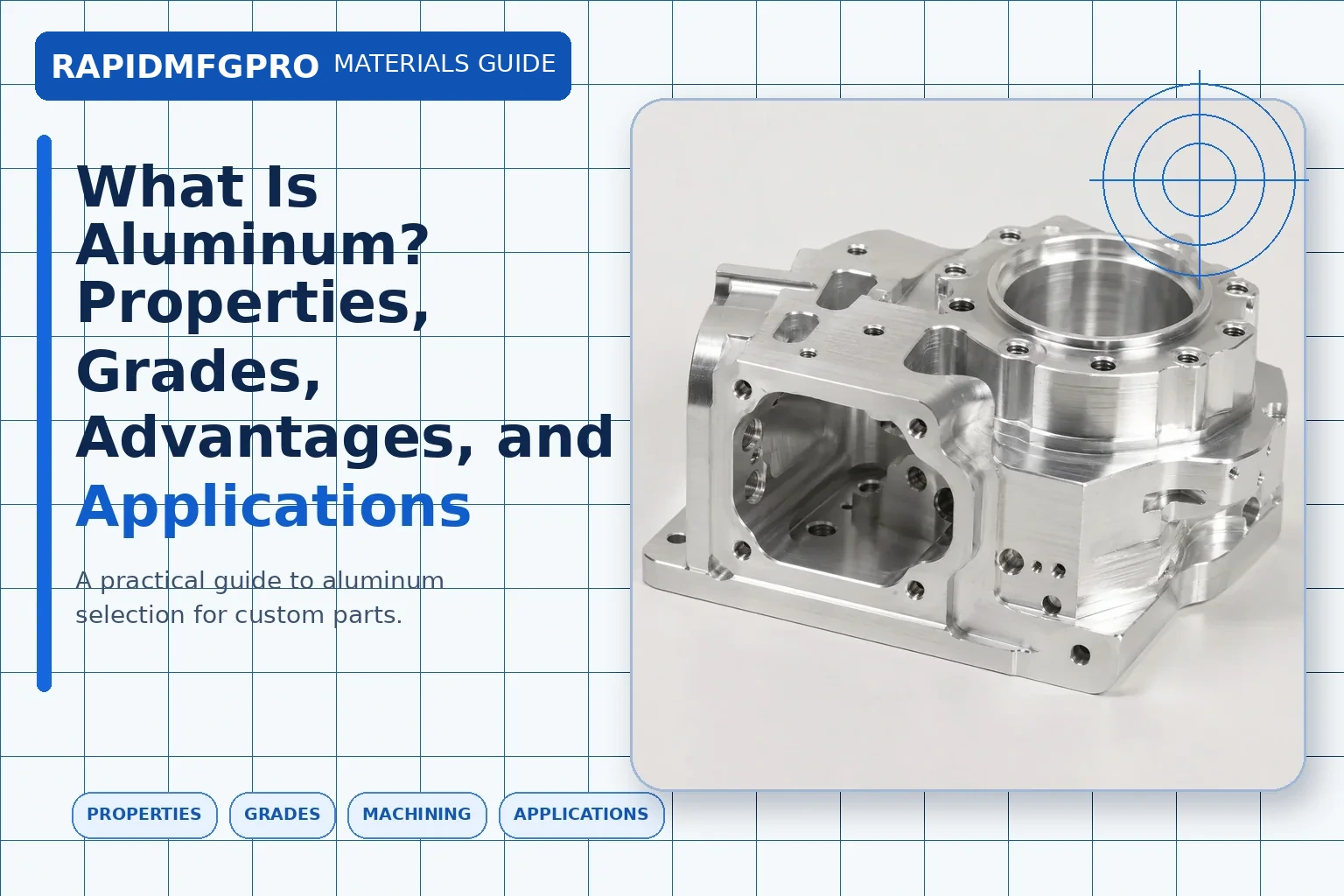
Aluminum is a lightweight, corrosion-resistant, non-ferrous metal used in aircraft, electric vehicles, industrial equipment, electronics, medical devices, robots, optical instruments, and consumer products. Its low density helps reduce product weight, while its machinability, thermal performance, and broad range of surface treatments make it suitable for both functional and visible components.
Selecting aluminum is not as simple as placing the word “aluminum” on a drawing. Engineers must also define the alloy, temper, product form, production process, dimensional tolerances, surface finish, and inspection requirements. A grade that performs well in one process may create unnecessary cost or manufacturing risk in another.
RapidMFGPro approaches aluminum projects as a manufacturing resource and supplier-matching platform. The platform evaluates the technical package, identifies the capabilities needed for production, and helps connect the project with suppliers whose material experience, equipment, finishing resources, and quality controls match the requirement.
This guide explains aluminum from an engineering and purchasing perspective. Each section addresses one clear topic so that designers and buyers can use the information when selecting materials, preparing drawings, comparing manufacturing routes, or reviewing suppliers.
What Is Aluminum?
Aluminum is a chemical element and a widely used engineering material. In manufacturing, the term normally refers either to commercially pure aluminum or to an aluminum alloy supplied in a controlled material condition.
Definition of Aluminum
Aluminum has the chemical symbol Al and atomic number 13. In its metallic form, it has a silver-gray appearance, relatively low density, good ductility, useful conductivity, and non-magnetic behavior.
Natural aluminum is normally found in compounds rather than as free metal. Industrial production separates aluminum from aluminum-bearing minerals, refines it, and converts it into metal that can be cast or mechanically processed.
Production of Aluminum
Primary aluminum production begins with mineral extraction and refining. The resulting aluminum is then cast into large forms that can be rolled, extruded, forged, or remelted for casting.
Common commercial product forms include:
- Sheet
- Plate
- Round bar
- Rectangular bar
- Tube
- Extruded profile
- Forged blank
- Cast blank
Product form matters because it affects grain direction, residual stress, available sizes, mechanical properties, and manufacturing cost.
Use of Aluminum Alloys
Pure aluminum offers excellent conductivity, corrosion resistance, and formability, but it is relatively soft. Most structural and precision parts therefore use aluminum alloys.
Alloying elements such as magnesium, silicon, copper, manganese, and zinc change the material’s strength, hardness, machinability, corrosion resistance, weldability, and heat treatment response.
A complete manufacturing specification should identify the alloy and the temper. “6061-T651 plate” is much more useful than a general note stating only “aluminum.”
Why Is Aluminum Lightweight?
Aluminum is selected in many products because its density is much lower than that of steel, copper, and several other common engineering metals. This property makes weight reduction possible without automatically moving to a polymer or an expensive specialty metal.
Density of Aluminum
Many common aluminum alloys have a density of approximately 2.7 to 2.8 g/cm³. Ordinary carbon steel is roughly three times as dense.
The weight difference becomes significant in large structures, moving assemblies, and products that must be transported frequently.
Effect on Product Performance
Lower mass can improve acceleration, payload capacity, handling, energy consumption, and shipping efficiency.
Applications that benefit directly from reduced weight include:
- Aircraft structures
- Electric vehicle systems
- Robot arms
- Drones
- Portable medical equipment
- Camera assemblies
- Mobile automation equipment
Design Caution for Lightweight Parts
Lower density does not mean that a steel part can always be copied in aluminum with the same geometry. Aluminum is less stiff than steel, so a direct material substitution may create excessive deflection.
Designers often compensate by increasing section depth, adding ribs, reducing unsupported spans, or using hollow profiles.
How Strong Is Aluminum?
Aluminum covers a wide range of strength levels. The strength of a finished part depends on the alloy, temper, product form, thickness, grain direction, and service temperature.
Yield Strength
Yield strength indicates the stress level at which permanent deformation begins. Soft, annealed aluminum has relatively low yield strength, while heat-treated aerospace grades can be several times stronger.
Yield strength is important for brackets, housings, frames, fixtures, and other parts that must return to their original shape after loading.
Tensile Strength
Tensile strength represents the maximum tensile stress that the material can withstand before fracture. It is useful when comparing alloys, but it should not be the only selection criterion.
A part may fail through excessive deflection, fatigue, wear, thread stripping, or corrosion before it reaches its tensile limit.
Fatigue Performance
Fatigue becomes important when a component experiences repeated loading. Aircraft fittings, robot joints, vehicle parts, and vibration-sensitive structures may require fatigue review even when their static load is moderate.
Surface defects, sharp corners, machining marks, holes, and abrupt section changes can increase local stress and shorten fatigue life.
How Stiff Is Aluminum?
Stiffness describes how much a material deflects under load. It is different from strength. A part can remain below its yield strength but still bend enough to lose alignment or function.
Elastic Modulus
Common aluminum alloys have an elastic modulus near 69 GPa. This is much lower than the modulus of steel.
Changing from 6061 to 7075 can increase strength significantly, but it does not create a similar increase in elastic modulus.
Geometry of Stiff Parts
Section geometry often has a greater effect on stiffness than alloy choice. A deeper section, ribbed wall, closed box, or wider support area can reduce deflection efficiently.
This principle is important for optical bases, machine plates, robot arms, long brackets, and bearing supports.
Stiffness in Mixed-Material Assemblies
Aluminum components are often assembled with steel shafts, fasteners, or frames. Different stiffness values can cause uneven load sharing or movement at the joint.
The design should evaluate contact area, fastener spacing, local bearing stress, and the deformation of each material.
How Does Aluminum Resist Corrosion?
Aluminum has useful natural corrosion resistance because its surface reacts with oxygen and forms a thin oxide film. This film adheres to the base metal and slows further attack in many normal environments.
Protective Oxide Layer
The natural oxide layer forms quickly when fresh aluminum is exposed to air. Unlike loose iron rust, it generally remains attached to the surface.
This behavior allows untreated aluminum to perform well in many indoor, atmospheric, and moderately humid conditions.
Limits of Natural Protection
Aluminum can still corrode in chloride-rich, acidic, alkaline, or continuously wet environments. Crevices and trapped moisture can also reduce protection.
Marine equipment, outdoor assemblies, chemical-processing parts, and frequently washed components may require a suitable alloy plus an engineered surface treatment.
Galvanic Corrosion
Galvanic corrosion can occur when aluminum contacts a more noble material in the presence of an electrolyte such as water.
Steel fasteners, copper parts, brass fittings, and carbon-fiber structures may create elevated risk. Designers can use coatings, isolating washers, sealants, suitable fasteners, or drainage features to reduce exposure.
How Does Aluminum Conduct Heat?
Aluminum transfers heat more effectively than steel and many engineering plastics. This property makes it useful where heat must be spread, removed, or transferred between components.
Thermal Conductivity
Thermal conductivity varies by alloy and temper. High-purity aluminum generally conducts heat better than high-strength alloyed grades.
Material data should be checked when thermal performance is a critical design requirement, because using one general aluminum value may create inaccurate calculations.
Thermal Management Parts
Common aluminum thermal components include:
- Heat sinks
- Liquid cold plates
- Battery cooling plates
- LED housings
- Motor housings
- Power electronics enclosures
- Thermal interface plates
Geometry, contact pressure, flatness, coolant flow, fin design, and interface materials may be as important as the alloy itself.
Thermal Expansion
Aluminum expands more with temperature than steel. Dimensional change may become important in long components, precision fits, optical assemblies, or mixed-material structures.
The drawing and inspection plan should define the reference temperature when thermal expansion could affect acceptance.
How Does Aluminum Conduct Electricity?
Aluminum is electrically conductive and is used in power, grounding, shielding, and electrical distribution applications. Conductivity depends on alloy composition and material condition.
Conductive Aluminum Grades
High-purity 1xxx-series aluminum generally provides higher conductivity than structural 6xxx-series or high-strength 7xxx-series alloys.
Electrical components should use a grade selected for the required balance of conductivity, strength, corrosion resistance, and manufacturability.
Electrical Contact Surfaces
Good conductivity through the bulk material does not guarantee low-resistance contact at an assembled joint. Oxide, contamination, coating, insufficient pressure, or surface irregularity can increase contact resistance.
Critical contact areas may require cleaning, masking, plating, controlled flatness, or defined assembly torque.
Effect of Surface Treatment
Anodizing produces an electrically insulating surface. Powder coating and most paints are also insulating.
Where grounding or continuity is required, the drawing should identify areas that must remain conductive. These regions may be masked during finishing or machined afterward.
Which Aluminum Properties Matter in Design?
Different applications prioritize different material properties. The table below summarizes common characteristics and explains why each one matters during product development.
| Property | Typical Behavior | Design Relevance |
|---|---|---|
| Density | Approximately 2.7–2.8 g/cm³ | Supports lightweight structures |
| Elastic modulus | Approximately 69 GPa | Requires geometry control for stiffness |
| Thermal conductivity | Moderate to high | Supports heat spreading |
| Electrical conductivity | Depends strongly on alloy | Influences conductor selection |
| Thermal expansion | Higher than steel | Affects precision assemblies |
| Corrosion resistance | Good in many environments | May reduce coating requirements |
| Magnetic response | Generally non-magnetic | Useful near sensors |
| Machinability | Good for many grades | Supports efficient CNC production |
How Are Aluminum Grades Classified?
Aluminum grades are classified according to composition and production route. Wrought alloys use one designation system, while cast alloys use another.
Wrought Aluminum
Wrought alloys are mechanically processed after casting. They are supplied as sheet, plate, bar, tube, extrusion, foil, or forging.
Wrought grades are widely used for CNC machining, sheet-metal fabrication, extrusion, and structural assemblies.
Cast Aluminum
Cast alloys are melted and formed inside a mold or die. Their compositions are selected to support fluidity, mold filling, shrinkage control, and casting performance.
Cast components may require secondary machining on holes, sealing faces, threads, datums, or bearing locations.
Wrought Alloy Series
The first digit of a wrought aluminum designation identifies the principal alloy family. Each family has a typical range of properties and applications.
| Series | Primary Element | Typical Behavior | Common Use |
|---|---|---|---|
| 1xxx | High-purity aluminum | High conductivity, low strength | Electrical parts |
| 2xxx | Copper | High strength, lower corrosion resistance | Aerospace parts |
| 3xxx | Manganese | Good formability, moderate strength | Formed sheet |
| 4xxx | Silicon | Specialized melting and wear behavior | Filler material |
| 5xxx | Magnesium | Good corrosion resistance | Marine fabrication |
| 6xxx | Magnesium plus silicon | Balanced general performance | Machined parts |
| 7xxx | Zinc | Very high strength | Loaded structures |
| 8xxx | Other elements | Specialized properties | Foil and specialty products |
What Does an Aluminum Temper Mean?
The temper identifies the thermal or mechanical condition of the material. It affects strength, hardness, formability, residual stress, and dimensional stability.
F Temper
F means as fabricated. The material is supplied in the condition produced by the manufacturing process without a separately defined control of mechanical properties.
O Temper
O means annealed. The material is relatively soft and formable, making it suitable for operations that require substantial deformation.
H Temper
H identifies strain-hardened material. This condition is common in non-heat-treatable sheet alloys such as 5052.
T Temper
T identifies thermally treated material. Additional numbers define the specific heat treatment sequence.
T6 indicates solution heat treatment followed by artificial aging. T651 adds a stress-relieving operation that can improve dimensional stability during machining.
Which Aluminum Grades Are Common?
Several grades appear frequently because they provide useful property combinations and broad commercial availability. Each grade should still be matched to the part geometry, environment, process, and finish.
1100 Aluminum
1100 is a high-purity aluminum grade with excellent formability, corrosion resistance, and conductivity. Its strength is relatively low.
It is used for formed sheet, chemical equipment, decorative parts, heat-exchanger components, and electrical applications.
2024 Aluminum
2024 is a copper-containing high-strength alloy used in aerospace structures, fittings, and loaded machined components.
It provides good fatigue performance but normally requires more corrosion protection than common 5xxx-series or 6xxx-series grades.
5052 Aluminum
5052 is a non-heat-treatable aluminum-magnesium alloy known for formability, corrosion resistance, and weldability.
It is widely used for sheet-metal enclosures, chassis, covers, trays, panels, and marine sheet components.
5083 Aluminum
5083 provides strong corrosion resistance in marine environments and good welded performance.
It is used for tanks, marine structures, transportation equipment, heavy plate, and welded assemblies.
6061 Aluminum
6061 is a versatile structural alloy used for CNC machining, extrusion, fixtures, frames, housings, robot components, and general industrial parts.
It offers a practical balance of strength, corrosion resistance, machinability, weldability, and finishing performance.
6063 Aluminum
6063 is commonly selected for extruded profiles that require good surface appearance and reliable anodizing.
Typical products include rails, frames, architectural profiles, trim, and equipment sections.
6082 Aluminum
6082 is a structural 6xxx-series grade commonly used for machinery, transport components, frames, and higher-strength machined parts.
Its availability may vary by region, so the supplier should confirm stock form, temper, and certification before production.
7075 Aluminum
7075 provides very high strength and is used for aerospace brackets, structural fittings, precision tooling, and high-load machine components.
It is less weldable than 6061 and may require more attention to corrosion protection, material traceability, and machining stability.
A356 Aluminum
A356 is a casting alloy commonly used in sand casting and permanent-mold casting. It can be heat treated to improve mechanical performance.
Applications include structural castings, housings, wheels, pump components, and industrial equipment.
ADC12 Aluminum
ADC12 is widely used for high-pressure die casting. It provides good mold filling and is suitable for complex high-volume components.
Common products include electronic housings, automotive covers, motor components, and industrial enclosures.
| Grade | Typical Strength | Main Advantage | Typical Process |
|---|---|---|---|
| 1100 | Low | Conductivity | Sheet forming |
| 2024 | High | Fatigue performance | Aerospace machining |
| 5052 | Moderate | Formability | Sheet fabrication |
| 5083 | Moderate to high | Marine resistance | Welded fabrication |
| 6061 | Moderate | Balanced performance | CNC machining |
| 6063 | Moderate | Extrusion appearance | Extrusion |
| 6082 | Moderate to high | Structural performance | Machining |
| 7075 | Very high | High load capacity | Precision machining |
| A356 | Moderate | Heat-treatable casting | Permanent-mold casting |
| ADC12 | Moderate | Die-filling performance | Die casting |
Why Do Engineers Choose Aluminum?
Aluminum is chosen when a project needs a practical balance of weight, strength, manufacturability, corrosion resistance, thermal behavior, and appearance.
Weight Reduction
Aluminum can reduce the mass of structures, mobile equipment, vehicles, and handheld products.
The greatest benefit occurs when the geometry is redesigned around aluminum rather than copied directly from a steel part.
Machinability
Many aluminum grades can be cut at high speeds and produce good surface finish with suitable tools, coolant, chip evacuation, and workholding.
This makes aluminum attractive for prototypes, precision housings, fixtures, and low-to-medium-volume parts.
Formability
Certain aluminum grades can be bent, drawn, stamped, or rolled efficiently. Sheet-metal parts can often be produced with fewer machining operations than billet components.
Grade and temper selection are critical because a hard temper can crack during a bend that a softer temper completes successfully.
Surface Appearance
Aluminum can be bead blasted, brushed, polished, anodized, painted, powder coated, or plated.
This flexibility supports industrial parts, consumer-facing housings, optical equipment, and branded products.
Recyclability
Aluminum can be recycled repeatedly. Recycled aluminum is widely used in commercial material streams.
Buyers with environmental reporting requirements should confirm the supplier’s material source, recycled-content documentation, and traceability method.
What Are the Limitations of Aluminum?
Aluminum is versatile, but it is not ideal for every application. Design and sourcing decisions should account for stiffness, residual stress, thread strength, temperature, corrosion exposure, and finishing behavior.
Low Stiffness
Aluminum deflects more than steel when the geometry and load are equal. This can affect alignment, flatness, vibration, and bearing support.
Machining Distortion
Removing large amounts of material can release residual stress. Thin walls, deep pockets, and asymmetric machining can cause bowing or twisting.
Stress-relieved plate, balanced roughing, controlled clamping, and finishing passes can reduce this risk.
Burr Formation
Soft aluminum grades can form burrs, smeared edges, or built-up material on the cutting tool.
Tool sharpness, cutting parameters, coolant, and deburring methods should match the alloy and geometry.
Thread Wear
Aluminum threads can wear or strip under repeated assembly. High-load joints may require longer engagement, larger threads, helical inserts, or solid threaded inserts.
Galvanic Attack
Contact with steel, copper, brass, or carbon fiber can create galvanic corrosion when moisture is present.
Isolation, sealing, drainage, suitable fasteners, and compatible coatings may be required.
Temperature Sensitivity
Aluminum loses strength as temperature rises and expands more than steel. High-temperature service and mixed-material precision assemblies require additional analysis.
How Is Aluminum CNC Machined?
CNC machining is suitable for prototypes, precision components, low-volume production, and parts that require complex holes, pockets, datums, or sealing surfaces.
CNC Milling
Milling produces brackets, housings, manifolds, cold plates, optical bases, heat sinks, and structural components.
Cost is influenced by stock size, material removal, setup count, tool access, tolerance, surface finish, and inspection requirements.
CNC Turning
Turning produces shafts, sleeves, bushings, connectors, spacers, threaded components, and cylindrical housings.
Long slender parts may require additional support to control vibration and deflection.
Five-Axis Machining
Five-axis machining supports complex aerospace, robotics, medical, and optical parts with angled faces or features that are difficult to reach in conventional setups.
It can reduce repositioning error, but machine time, programming, tooling, and inspection complexity may increase.
How Is Aluminum Sheet Fabricated?
Sheet-metal fabrication is used for enclosures, covers, panels, brackets, trays, chassis, and guards. It is often more economical than billet machining when the geometry is thin and open.
Sheet Cutting
Aluminum sheet can be laser cut, punched, sheared, or routed. The process depends on thickness, quantity, edge requirement, hole size, and available equipment.
Sheet Bending
Bending requires a suitable alloy, temper, grain direction, inside radius, and bend allowance.
5052-H32 is commonly chosen for bent enclosures because it generally forms more reliably than 6061-T6 sheet.
Sheet Joining
Sheet assemblies may use welding, riveting, clinching, threaded inserts, screws, or adhesives.
Joint choice should reflect load, access, appearance, service requirements, and future maintenance.
How Is Aluminum Extruded?
Extrusion forces heated aluminum through a shaped die to produce a long profile with a constant cross-section. It is suitable for frames, rails, heat sinks, channels, and machine structures.
Profile Design
Extruded profiles should use practical wall thickness, balanced geometry, achievable corner radii, and suitable hollow sections.
Extreme thickness changes or unsupported features can increase die complexity and dimensional variation.
Secondary Machining
Extrusions often require cutting, drilling, milling, tapping, deburring, anodizing, and assembly after the profile is produced.
Critical dimensions should distinguish between the extrusion tolerance and the secondary machining tolerance.
Production Quantity
Extrusion requires a die, so it is usually more attractive when the expected quantity justifies tooling.
Early prototypes may be machined from standard profiles or billet before a custom extrusion is released.
How Is Aluminum Cast?
Casting is used when geometry, production volume, or material utilization makes billet machining inefficient. Each casting process has different tooling, tolerance, surface, and porosity characteristics.
Sand Casting
Sand casting is suitable for large parts, complex shapes, and lower quantities. Tooling is generally less expensive than high-pressure die-casting tooling.
Surface finish and dimensional tolerance are usually less precise, so secondary machining may be required.
Permanent-Mold Casting
Permanent-mold casting uses a reusable metal mold. It can provide better repeatability and surface quality than sand casting.
It is often used for medium-volume structural components and heat-treated casting alloys.
Die Casting
High-pressure die casting is suited to high-volume parts with thin walls, ribs, bosses, and integrated features.
Tooling cost is high, and porosity must be considered for leak-tight parts, welding, heat treatment, and critical machined surfaces.
| Process | Typical Quantity | Main Benefit | Main Risk |
|---|---|---|---|
| CNC machining | Prototype to medium volume | No production mold | Material waste |
| Sheet fabrication | Low to high volume | Efficient thin structures | Bend limitations |
| Extrusion | Medium to high volume | Efficient constant profile | Die requirement |
| Sand casting | Low to medium volume | Large complex shapes | Wide tolerances |
| Permanent-mold casting | Medium volume | Good repeatability | Tooling cost |
| Die casting | High volume | Thin walls | Porosity |
How Should Aluminum Parts Be Designed?
Aluminum part design should reflect the selected production process. Geometry that is easy to machine may not be suitable for casting, while a good sheet-metal design may not work as an extrusion.
Wall Thickness
Thin walls can move during machining, bending, welding, finishing, and inspection. Wall thickness should be consistent where possible.
Ribs or local supports can improve rigidity without making the entire part heavy.
Pocket Depth
Deep pockets require long cutting tools. Tool deflection and vibration can reduce accuracy and surface quality.
A shallower pocket, larger opening, alternate machining direction, or divided assembly may reduce cost.
Internal Radius
CNC milling tools cannot create a perfectly sharp internal vertical corner. The drawing should include an achievable radius.
Larger radii allow stronger tools, faster cutting, better tool life, and more stable dimensions.
Tolerance
Tight tolerances should be limited to features that control fit, sealing, alignment, or function.
Applying tight tolerances to every dimension increases manufacturing and inspection cost without necessarily improving the product.
Thread Design
Thread size, engagement length, blind-hole depth, insert type, and assembly torque should be defined according to the load and service frequency.
Frequently assembled joints may benefit from steel inserts.
Which Surface Treatment Suits Aluminum?
The correct finish depends on corrosion exposure, wear, appearance, conductivity, dimensional allowance, and cost. Surface treatment should be defined before finalizing fits, threads, masking, and inspection.
Anodizing
Anodizing increases the oxide layer through an electrochemical process. It can improve corrosion resistance, appearance, wear performance, and surface hardness.
The coating is electrically insulating and affects dimensions, so critical bores, threads, and contact areas may require masking.
Hard Anodizing
Hard anodizing creates a thicker, more wear-resistant layer. It is used on sliding parts, fixtures, mechanisms, and functional surfaces.
Coating thickness and dimensional growth should be considered when defining fits.
Conversion Coating
Chemical conversion coating creates a thin protective film. It is often used for corrosion protection, paint preparation, or conductive electrical contact.
It introduces less dimensional change than anodizing.
Powder Coating
Powder coating provides color, environmental protection, and a uniform visible finish. It is commonly used on enclosures, frames, guards, and outdoor equipment.
The coating is relatively thick and can interfere with threads, fits, and grounding surfaces.
Wet Painting
Wet painting supports custom colors, specialized primers, and controlled coating systems.
Surface cleaning and pretreatment are essential for adhesion.
Electroless Nickel Plating
Electroless nickel plating can improve wear resistance, corrosion performance, and surface conductivity.
Aluminum requires suitable activation before plating. Coating thickness should be included in dimensional planning.
| Finish | Primary Purpose | Dimensional Effect | Electrical Result |
|---|---|---|---|
| Anodizing | Appearance and corrosion resistance | Moderate | Insulating |
| Hard anodizing | Wear resistance | Higher | Insulating |
| Conversion coating | Corrosion protection | Very low | Can remain conductive |
| Powder coating | Color and environmental protection | High | Insulating |
| Wet painting | Specialized coating system | Process dependent | Usually insulating |
| Electroless nickel | Wear and metallic surface | Controlled buildup | Conductive |
Where Is Aluminum Used?
Aluminum is used across industries because different alloys and processes can deliver lightweight structures, thermal components, corrosion-resistant products, and visible housings.
Aerospace
Aerospace applications include structural brackets, fittings, avionics housings, seat components, satellite parts, and ground-support equipment.
High-strength alloys may require certified material, traceability, first-article inspection, and controlled surface treatment.
Automotive
Automotive applications include battery enclosures, motor housings, cooling plates, suspension parts, sensor brackets, structural extrusions, and prototype components.
CNC machining may support development, while extrusion or die casting may support production.
Electronics
Electronics use aluminum for heat sinks, power housings, shielding enclosures, instrument panels, and thermal interface components.
Thermal performance, grounding, coating, and cosmetic appearance often need to be reviewed together at the drawing stage.
Robotics
Robotics applications include arm links, joint housings, end-effector plates, motor mounts, sensor brackets, and base structures.
Low moving mass can improve response, but stiffness and fatigue remain important.
Optical Equipment
Optical equipment uses aluminum for lens mounts, detector housings, laser housings, camera bodies, optical bases, and instrument frames.
Flatness, positional tolerance, thermal expansion, surface treatment, and stray-light control may be critical.
Medical Equipment
Medical equipment uses aluminum for instrument housings, frames, brackets, supports, laboratory equipment, and portable device structures.
Cleaning chemicals, sterilization exposure, documentation, and cosmetic acceptance may affect the final specification.
Industrial Equipment
Industrial applications include pneumatic manifolds, fixtures, tooling plates, conveyor parts, machine guards, frames, and automation components.
The process may range from a one-off machined prototype to a production casting or extrusion.
How Do You Select an Aluminum Grade?
Grade selection should begin with service requirements and then move to manufacturing requirements. The best technical material may still be impractical if it is unavailable in the required form, size, temper, or quantity.
Load Requirement
Identify the expected static load, impact load, vibration, fatigue cycle, and required safety factor.
Strength should be separated from stiffness during the calculation.
Environmental Exposure
Confirm whether the part will contact saltwater, cleaning chemicals, condensation, fuels, food products, or outdoor weather.
The environment determines whether the natural oxide layer is sufficient or an engineered finish is required.
Production Process
Match the grade to the intended process. 5052 sheet may suit bending, 6061-T651 plate may suit machining, 6063 may suit extrusion, and ADC12 may suit die casting.
Product Quantity
A prototype may be CNC machined from billet, while a high-volume part may justify extrusion or casting tooling.
Future production quantity should be considered before the prototype geometry is frozen.
Material Availability
Confirm stock size, temper, regional availability, minimum purchase quantity, lead time, and certification.
An uncommon material condition can delay the project more than machining.
Surface Requirement
The grade should support the required anodized color, polished appearance, conductive coating, or corrosion performance.
Cosmetic requirements may require controlled material batches and approved samples.
How Does RapidMFGPro Evaluate Aluminum Projects?
RapidMFGPro reviews aluminum projects from the perspective of supplier suitability. The goal is to identify which manufacturing capabilities are needed before matching the requirement with potential suppliers.
Drawing Review
The review begins with the 3D model, 2D drawing, material specification, quantity, finish, tolerances, and inspection notes.
Missing information is identified before supplier comparison because incomplete drawings can produce quotations based on different assumptions.
Process Review
RapidMFGPro considers whether the part is better suited to CNC machining, sheet fabrication, extrusion, casting, or a combination of processes.
The review also considers whether the process should change when production quantity increases.
Supplier Matching
Suppliers are considered according to machine capacity, alloy experience, process capability, production volume, finishing resources, inspection equipment, and export readiness.
A supplier that is suitable for a 6061 prototype may not be suitable for a 7075 aerospace component or a high-volume ADC12 housing.
Supplier Quality Review
The proposed supplier should confirm material traceability, inspection method, finish control, documentation, packaging, and production plan.
Depending on the project, required records may include:
- Material certificate
- Certificate of conformity
- First article inspection report
- Dimensional report
- Coating certificate
- Heat-treatment record
- Lot traceability
- Packaging record
How Should Aluminum Parts Be Inspected?
Aluminum part inspection should confirm material identity, dimensional accuracy, surface condition, coating quality, and functional performance. The inspection plan should match the application risk.
Material Verification
Material verification may include alloy, temper, product form, certificate, heat number, supplier source, and lot traceability.
Safety-critical or regulated parts may require positive material identification or additional documentation.
Dimensional Inspection
Dimensional checks may use calipers, micrometers, height gauges, bore gauges, thread gauges, optical systems, or coordinate measuring machines.
Critical features should be measured from the drawing datums rather than from convenient but unrelated surfaces.
Surface Inspection
Surface inspection looks for burrs, scratches, dents, chatter, tool marks, stains, oxidation, and handling damage.
Cosmetic criteria should define viewing distance, lighting, acceptable defect size, and controlled surfaces.
Coating Inspection
Coated parts may require thickness measurement, color comparison, adhesion checks, masking verification, and conductivity testing.
Threads, sealing surfaces, bores, and grounding areas require special attention.
Functional Inspection
Functional checks may include thread assembly, bearing fit, seal installation, leak testing, flow testing, electrical continuity, or trial assembly.
A part can meet individual dimensions but still fail during assembly, so critical interfaces should be tested in a representative condition.
Frequently Asked Questions About Aluminum
These questions address common decisions that arise when engineers and buyers compare aluminum grades or manufacturing routes.
Is 6061 Suitable for CNC Machining?
Yes. 6061 is widely used for machined brackets, housings, fixtures, frames, manifolds, and industrial components.
6061-T651 plate may provide better dimensional stability than a non-stress-relieved product when substantial material must be removed.
Is 5052 Suitable for Bending?
Yes. 5052-H32 is commonly selected for bent sheet-metal parts because it provides good formability and corrosion resistance.
Bend radius, grain direction, thickness, and tooling still need to be considered.
Is 7075 Suitable for Welding?
7075 is generally not selected for conventional fusion welding because welding can create cracking and reduce mechanical performance.
Mechanical fastening, redesign, or another alloy may be more suitable.
Can Aluminum Replace Steel?
Aluminum can replace steel in some applications, but the geometry usually needs to change because aluminum is less stiff.
The replacement should be evaluated for deflection, fatigue, bearing stress, threads, corrosion, temperature, and joining.
Can Aluminum Be Anodized?
Many aluminum grades can be anodized, but the color, texture, and consistency vary by alloy, temper, material batch, weld condition, and surface preparation.
Cosmetic parts should use clear acceptance criteria and approved samples.
Conclusion
Aluminum is a versatile engineering material that can provide low weight, useful strength, corrosion resistance, thermal performance, electrical conductivity, machinability, and attractive surface finishes. Selecting the right aluminum requires a clear understanding of alloy, temper, product form, load, stiffness, environment, manufacturing process, quantity, coating, and inspection requirements. RapidMFGPro supports aluminum projects by reviewing the technical package, identifying the required production capabilities, and evaluating suppliers according to their material experience, equipment, finishing resources, and quality-control methods.
Need Help Reviewing a Custom Part?
Share your CAD file and requirements to request supplier matching. Supplier capability and commercial terms must be verified before order placement.
Request Supplier Match