Time to read: 20 min
When Should You Choose Steel Materials for Your Parts?
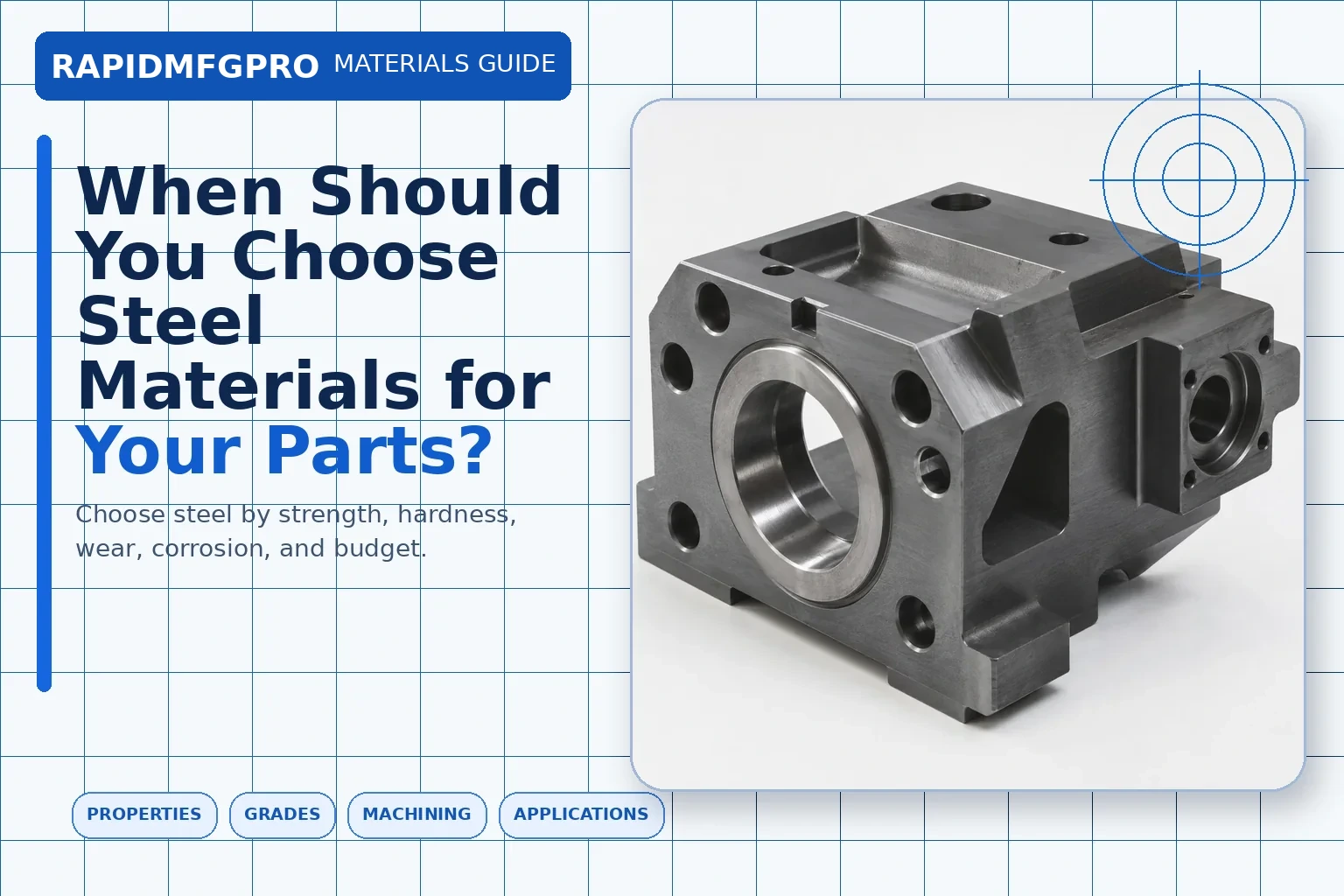
Steel is one of the most widely used engineering materials because it can provide high strength, high stiffness, wear resistance, heat-treatment flexibility, broad material availability, and economical production. It is used in machine frames, shafts, gears, brackets, fasteners, molds, tools, automotive components, construction equipment, robots, energy systems, and industrial machinery.
However, steel is not one material and it is not automatically the best choice for every part. Low-carbon steel, medium-carbon steel, alloy steel, spring steel, bearing steel, tool steel, and high-strength structural steel behave differently during machining, welding, forming, hardening, grinding, coating, and service.
A soft steel that is easy to weld may be unsuitable for a gear tooth. A high-carbon steel that can reach high hardness may crack during welding. An alloy steel may carry a heavy load but require controlled heat treatment and distortion management. A coated carbon-steel part may be more economical than stainless steel, but only when the environment and coating maintenance allow it.
RapidMFGPro evaluates steel projects from a manufacturing supplier-matching perspective. The platform reviews the required grade, condition, product form, quantity, geometry, heat treatment, finish, tolerances, inspection scope, and service environment before identifying suppliers with relevant machining, forming, forging, casting, heat-treatment, coating, and quality-control capabilities.
This guide explains when steel should be selected, how steel families differ, which grades are commonly used, how steel parts are manufactured, and what engineers and buyers should confirm before production.
When Should You Choose Steel?
Steel is usually a strong material choice when a part must carry high load, resist deflection, survive wear, accept heat treatment, or be produced economically at a useful strength level. Its advantages are most valuable when structural performance matters more than minimum weight.
High Load
Steel is well suited to parts that must carry static, impact, bending, torsional, or compressive loads. Shafts, gears, pins, machine bases, structural brackets, and heavy-duty fasteners commonly use steel because of its strength and predictable mechanical behavior.
Grade selection should reflect the type of load. A low-carbon steel bracket and a hardened alloy steel gear may both be steel parts, but they require very different material properties.
High Stiffness
Steel has much higher stiffness than aluminum and titanium. This allows a steel component to control deflection without requiring the same section depth that a lower-modulus material might need.
Machine structures, bearing supports, precision rails, long shafts, fixtures, and loaded plates often benefit from steel stiffness.
Wear Resistance
Selected steels can be hardened through heat treatment, surface hardening, or coating. This makes them suitable for sliding, rolling, cutting, forming, or repeated-contact applications.
Gears, cams, dies, punches, bearings, guide rails, and tooling components often require a steel grade designed for wear performance.
Cost-Controlled Strength
Steel often provides high structural strength at lower raw-material cost than titanium, nickel alloys, or high-strength copper alloys.
Material price is only one part of total cost. Machining time, heat treatment, straightening, coating, inspection, and maintenance should also be considered.
| Part Requirement | Steel Suitability | Reason |
|---|---|---|
| High-load shaft | High | Steel provides strength, stiffness, and heat-treatment options |
| Lightweight moving arm | Conditional | Aluminum or titanium may reduce mass |
| Wear-resistant gear | High | Alloy steel can be carburized or hardened |
| Wet outdoor bracket | Conditional | Coating or stainless steel may be required |
| High-conductivity busbar | Low | Copper or aluminum is more suitable |
| Low-cost welded frame | High | Low-carbon steel is economical and weldable |
When Is Steel Not the First Choice?
Steel can add unnecessary weight, corrosion risk, coating work, or machining effort when another material better matches the application. It should be selected because of a clear mechanical or economic advantage.
Weight-Critical Parts
Steel is significantly denser than aluminum and titanium. In aerospace, mobile robotics, portable equipment, and high-speed moving systems, additional mass can reduce efficiency or response.
A steel design may still be competitive if its higher stiffness allows a much smaller section, but this should be calculated rather than assumed.
Severe Corrosion
Carbon and alloy steels rust when exposed to moisture and oxygen. Paint, plating, conversion coating, oil, or another protective system may be required.
Stainless steel, titanium, plastic, or a non-ferrous alloy may be more practical when the coating is difficult to maintain or when corrosion could create contamination.
Thermal Conductivity
Steel conducts heat less effectively than copper and aluminum. It is usually not the first choice for heat sinks, heat spreaders, busbars, or high-performance cold plates.
Steel may still be used for pressure containment, wear surfaces, or structural support around a more conductive insert.
Magnetic Sensitivity
Many steels are magnetic. This can interfere with sensors, imaging equipment, magnetic fields, or specialized electronic systems.
Austenitic stainless steel, aluminum, titanium, copper, or engineering plastics may be considered where low magnetic response is important.
What Is Steel?
Steel is an iron-based alloy containing carbon and often other alloying elements. The amount of carbon and the added elements determine strength, hardness, toughness, weldability, machinability, hardenability, and corrosion behavior.
Iron Base
Iron provides the main metallic matrix in steel. Pure iron is relatively soft, so carbon and alloying additions are used to create engineering properties suitable for structural and mechanical parts.
Steel is different from cast iron, which generally contains more carbon and has different casting, machining, strength, and fracture behavior.
Carbon Content
Carbon is one of the most important elements in steel. Increasing carbon generally raises achievable hardness and strength, but it can reduce ductility and weldability.
Low-carbon steels are commonly formed and welded. Medium-carbon steels are used for stronger shafts and components. High-carbon steels are used for springs, cutting edges, and wear parts.
Alloying Elements
Chromium, nickel, molybdenum, manganese, silicon, vanadium, tungsten, boron, cobalt, and other elements may be added to control performance.
Alloying can improve hardenability, toughness, wear, hot strength, corrosion resistance, grain control, or fatigue performance.
Steel Product Forms
Steel is supplied in forms suited to different manufacturing routes.
Common product forms include:
- Sheet
- Plate
- Round bar
- Square bar
- Tube
- Pipe
- Structural section
- Forged billet
- Cast blank
- Ground stock
Product form affects grain flow, residual stress, dimensional allowance, stock availability, and manufacturing cost.
How Does Carbon Change Steel?
Carbon content changes the balance between strength, hardness, ductility, toughness, welding, and machining. It is one of the first variables to review when selecting a steel family.
Low-Carbon Behavior
Low-carbon steel is generally ductile, formable, weldable, and economical. It is commonly used for sheet-metal parts, frames, brackets, housings, and general structures.
Its through-hardening response is limited, but the surface may be carburized or treated in selected applications.
Medium-Carbon Behavior
Medium-carbon steel offers higher strength and better heat-treatment response than low-carbon steel.
It is widely used for shafts, axles, pins, gears, connecting parts, and machine components.
High-Carbon Behavior
High-carbon steel can reach high hardness and wear resistance after heat treatment.
It is used for springs, blades, cutting components, wear strips, and selected tooling. Welding and forming become more difficult as carbon increases.
Carbon Equivalent
Carbon equivalent is used to estimate welding difficulty by considering carbon and selected alloying elements.
A higher value may indicate greater need for preheating, controlled heat input, suitable filler, or post-weld treatment.
Which Steel Family Fits the Part?
Steel families organize materials according to composition, manufacturing purpose, and expected properties. Selecting the family first helps narrow the grade efficiently.
Carbon Steel
Carbon steel uses carbon as the primary strengthening element. It is widely available and economical.
It is used for brackets, frames, shafts, plates, fasteners, weldments, and general machine parts.
Alloy Steel
Alloy steel contains controlled additions that improve hardenability, strength, toughness, fatigue, or wear.
Gears, high-load shafts, automotive components, pressure parts, and heavy equipment often use alloy steel.
Tool Steel
Tool steel is designed for cutting, forming, molding, or wearing against other materials.
It is used for dies, punches, molds, cutters, gauges, and precision wear parts.
Spring Steel
Spring steel provides high elastic strength and fatigue resistance after suitable processing.
It is used for coil springs, flat springs, clips, retainers, washers, and flexible mechanisms.
Bearing Steel
Bearing steel is designed for high hardness, rolling-contact fatigue, dimensional stability, and controlled cleanliness.
Bearings, rollers, balls, races, and precision wear components commonly use bearing steel.
Structural Steel
Structural steel is selected for load-bearing frames, welded assemblies, equipment bases, and fabricated structures.
Strength, weldability, toughness, plate availability, and standard compliance are major selection factors.
| Steel Family | Main Benefit | Typical Heat Treatment | Common Use |
|---|---|---|---|
| Carbon steel | Economy and broad availability | Annealing or normalizing | Frames and general parts |
| Alloy steel | Strength and hardenability | Quench and temper | Gears and shafts |
| Tool steel | Wear and hot hardness | Grade-specific hardening | Dies and molds |
| Spring steel | Elastic strength | Hardening and tempering | Springs and clips |
| Bearing steel | Rolling-contact performance | Hardening and tempering | Bearing races and rollers |
| Structural steel | Welded load-bearing performance | Often supplied normalized or rolled | Frames and bases |
Which Low-Carbon Steel Grades Are Common?
Low-carbon steels are selected for weldability, forming, machining, low cost, and broad availability. They are common in fabricated and general-purpose parts.
AISI 1008 Steel
AISI 1008 is a low-carbon steel with good formability. It is commonly supplied as sheet, strip, or wire.
It is used for stamped parts, deep-drawn components, clips, covers, and low-load hardware.
AISI 1018 Steel
AISI 1018 provides good machinability, weldability, and dimensional consistency for a low-carbon steel.
It is used for shafts, pins, spacers, fasteners, fixtures, and general CNC-machined parts.
AISI 1020 Steel
AISI 1020 is used for machined, forged, welded, and carburized components.
Typical parts include shafts, brackets, bushings, couplings, and moderate-load machine components.
EN S235JR Steel
S235JR is a commonly used European structural steel grade.
It is used for welded frames, plates, supports, machine structures, and general fabrication.
Which Medium-Carbon Steel Grades Are Common?
Medium-carbon steels offer higher strength and better hardening response than low-carbon grades. They are commonly used for loaded mechanical parts.
AISI 1045 Steel
AISI 1045 is a widely used medium-carbon steel with useful strength, machinability, and heat-treatment response.
It is used for shafts, pins, gears, axles, rollers, and machine components.
EN C45 Steel
C45 is a European medium-carbon steel used in similar applications to AISI 1045.
It is common in shafts, couplings, machine parts, molds, and general mechanical components.
AISI 1050 Steel
AISI 1050 provides higher carbon content and can achieve increased hardness after treatment.
It is used for springs, wear parts, shafts, and components requiring moderate hardening.
AISI 1060 Steel
AISI 1060 is used where higher strength, spring behavior, or wear performance is required.
Welding becomes more difficult and heat-treatment control becomes more important.
Which Alloy Steel Grades Are Common?
Alloy steels are chosen when carbon steel does not provide sufficient hardenability, fatigue strength, toughness, or wear performance.
AISI 4140 Steel
AISI 4140 is a chromium-molybdenum alloy steel with broad use in machinery and automotive components.
It is used for shafts, gears, bolts, axles, tooling, fixtures, and high-load parts.
AISI 4340 Steel
AISI 4340 provides high strength, toughness, and fatigue performance after suitable heat treatment.
It is used for aircraft components, heavy shafts, landing-system parts, gears, and critical mechanical components.
AISI 8620 Steel
AISI 8620 is a low-carbon alloy steel commonly used for carburized parts.
It can provide a hard wear-resistant case with a tough core, making it suitable for gears, cams, pins, and shafts.
AISI 9310 Steel
AISI 9310 is a high-quality carburizing steel used for heavily loaded gears and aerospace transmission components.
Material cleanliness, heat treatment, grinding, and inspection are important for high-performance applications.
Which Tool Steel Grades Are Common?
Tool steels are selected for wear resistance, hardness, dimensional stability, toughness, or resistance to heat generated during forming and cutting.
A2 Tool Steel
A2 is an air-hardening tool steel with useful wear resistance and dimensional stability.
It is used for punches, dies, gauges, forming tools, and precision wear components.
D2 Tool Steel
D2 provides high wear resistance and high carbon-chromium content.
It is used for blanking dies, shear blades, punches, molds, and long-wear tooling.
O1 Tool Steel
O1 is an oil-hardening tool steel known for machinability in the annealed condition and useful dimensional control.
It is used for gauges, dies, knives, fixtures, and small tooling components.
H13 Tool Steel
H13 is a hot-work tool steel with resistance to thermal fatigue and high-temperature softening.
It is used for die-casting dies, extrusion tooling, forging dies, hot punches, and molds.
M2 High-Speed Steel
M2 provides high hardness and wear resistance at elevated cutting temperature.
It is used for drills, cutters, taps, broaches, and cutting tools.
Which Bearing Steel Grades Are Common?
Bearing steels require controlled hardness, cleanliness, dimensional stability, and rolling-contact fatigue performance.
AISI 52100 Steel
AISI 52100 is a high-carbon chromium bearing steel used for balls, rollers, races, and precision wear components.
It is commonly machined in a soft condition and then hardened, ground, and inspected.
GCr15 Steel
GCr15 is a widely used Chinese bearing steel with applications similar to 52100.
It is used for bearing rings, rolling elements, gauges, and wear-resistant precision components.
Carburized Bearing Steel
Carburized bearing steels provide a hard surface with a tougher core.
They may be selected for large bearings, shock-loaded systems, and components requiring surface fatigue strength.
How Do Common Steel Grades Compare?
Steel comparison should focus on strength, hardenability, welding, wear, machining, cost, and required heat treatment. One grade rarely leads in every category.
| Grade | Steel Type | Main Advantage | Main Limitation | Typical Part |
|---|---|---|---|---|
| 1018 | Low-carbon steel | Machinability and weldability | Limited through-hardening | Shafts and fixtures |
| 1045 | Medium-carbon steel | Balanced strength | Lower weldability than 1018 | Pins and axles |
| 4140 | Alloy steel | Strength and toughness | Heat-treatment control | Gears and shafts |
| 4340 | High-strength alloy steel | High toughness | Higher material and processing cost | Critical structural parts |
| 8620 | Carburizing alloy steel | Hard case with tough core | Carburizing distortion | Gears and cams |
| D2 | Tool steel | High wear resistance | Lower toughness than some tool steels | Punches and dies |
| H13 | Hot-work tool steel | Thermal-fatigue resistance | Specialized heat treatment | Die-casting tooling |
| 52100 | Bearing steel | Rolling-contact performance | Requires hardening and grinding | Bearing races |
How Does Steel Compare With Aluminum?
Steel and aluminum are commonly compared for structural and machined parts. The decision usually depends on weight, stiffness, strength, corrosion, manufacturing process, and cost.
Weight
Aluminum is much lighter than steel. It is often preferred for moving assemblies, portable equipment, aerospace products, and vehicles.
Steel may still produce a compact design because its higher stiffness allows a smaller section.
Stiffness
Steel is approximately three times as stiff as aluminum by elastic modulus.
This difference is important for rails, shafts, plates, machine structures, and alignment-sensitive components.
Corrosion
Aluminum forms a natural oxide film, while carbon steel normally needs coating in wet environments.
Steel coating cost and maintenance should be included in the material comparison.
Machining
Many aluminum grades machine faster than steel and create lower cutting forces.
Steel may provide better thread strength, wear performance, and dimensional rigidity.
How Does Steel Compare With Titanium?
Steel and titanium are compared in high-load, aerospace, medical, motorsport, and corrosion-sensitive applications.
Density
Titanium is lighter than steel. This can reduce mass in performance-critical structures.
Steel is usually more economical and broadly available.
Stiffness
Steel is significantly stiffer than titanium.
A titanium design may require a larger section to control deflection even when its strength is high.
Corrosion
Titanium provides excellent corrosion resistance in many demanding environments.
Carbon and alloy steels usually require protective coating or controlled service conditions.
Manufacturing Cost
Titanium raw material and machining are generally more expensive.
Steel is often preferred when weight and corrosion do not justify the titanium premium.
How Does Steel Compare With Stainless Steel?
Carbon or alloy steel is often compared with stainless steel when corrosion resistance and cost compete with strength, hardness, or machining requirements.
Material Cost
Carbon steel is generally less expensive than stainless steel.
Coating, maintenance, and replacement may reduce the long-term cost difference.
Corrosion Protection
Stainless steel provides corrosion resistance through its chromium-rich passive film.
Carbon steel relies on paint, plating, oil, conversion coating, or environmental control.
Heat Treatment
Many carbon and alloy steels provide broad hardening options.
Austenitic stainless grades such as 304 and 316 do not use conventional quench-and-temper hardening.
Machining
Many carbon steels machine more predictably than austenitic stainless steel.
Grade, hardness, sulfur content, and heat treatment strongly affect the comparison.
Why Is Steel Heat Treated?
Heat treatment changes steel microstructure to control hardness, strength, toughness, residual stress, machinability, and dimensional stability.
Annealing
Annealing softens steel, improves machinability, reduces internal stress, and prepares material for forming or later hardening.
Tool steels are often supplied in an annealed condition for machining.
Normalizing
Normalizing refines grain structure and can produce a more uniform condition than uncontrolled cooling.
It is used for forgings, castings, and carbon-steel components.
Hardening
Hardening typically involves heating steel into a controlled phase region and quenching it.
Quench medium, section size, grade, geometry, and agitation influence hardness and distortion.
Tempering
Tempering follows hardening and reduces brittleness while adjusting hardness and toughness.
The selected temperature determines the final property balance.
Stress Relieving
Stress relieving reduces residual stress created by machining, welding, forming, or heat treatment.
It may improve dimensional stability before finish machining.
When Is Case Hardening Used?
Case hardening creates a hard surface while retaining a tougher core. It is useful when wear and contact fatigue are concentrated near the surface.
Carburizing
Carburizing adds carbon to the surface of a low-carbon alloy steel before hardening.
It is widely used for gears, cams, shafts, pins, and transmission components.
Nitriding
Nitriding introduces nitrogen into the surface and can create high hardness with relatively low dimensional change.
It is used for gears, shafts, molds, screws, and wear components.
Induction Hardening
Induction hardening rapidly heats selected areas before quenching.
It is used for shaft journals, gear teeth, rails, pins, and localized wear surfaces.
Flame Hardening
Flame hardening uses a controlled flame to heat the surface before quenching.
It may be used for large parts and localized surfaces where induction equipment is not practical.
Why Does Heat Treatment Distort Steel?
Steel can change shape during heating, quenching, phase transformation, and stress release. Distortion should be planned before final machining and inspection.
Uneven Cooling
Different wall thicknesses cool at different rates. This creates uneven contraction and transformation.
Balanced geometry and suitable quenching methods can reduce distortion.
Residual Stress
Machining, forging, welding, and prior processing can leave stress in the material.
Heat treatment may release this stress and move the part.
Phase Transformation
Steel changes volume when its microstructure transforms during hardening.
Grade, hardness target, section thickness, and quench severity affect the dimensional result.
Finish Allowance
Critical parts are often rough machined before heat treatment and finish ground afterward.
The drawing and process plan should provide sufficient allowance for distortion correction.
How Is Steel CNC Milled?
CNC milling is used for steel brackets, housings, fixtures, molds, bases, manifolds, plates, and precision machine components.
Material Condition
Annealed or normalized steel is generally easier to machine than hardened steel.
The machining plan should state whether heat treatment occurs before or after cutting.
Tool Selection
Carbide grade, coating, edge geometry, flute count, and tool diameter should match steel hardness and cutting conditions.
Hardened tool steel may require specialized cutters or grinding.
Toolpath Strategy
Stable engagement reduces tool shock, heat, and uneven wear.
Adaptive milling can help control load in deep pockets and hard materials.
Coolant Control
Coolant supports heat control, lubrication, and chip evacuation.
Some hardened machining strategies may use air or minimum lubrication depending on tooling.
How Is Steel CNC Turned?
CNC turning produces shafts, pins, sleeves, bushings, fasteners, rollers, gears, and cylindrical machine components.
Chip Control
Steel grade, hardness, sulfur content, feed, and insert geometry affect chip formation.
Predictable chip breaking is important for automated production.
Long-Part Support
Slender steel shafts can deflect or vibrate even though steel is stiff.
Tailstocks, steady rests, guide bushings, or staged cutting may be required.
Hard Turning
Hardened steel may be finish turned with suitable inserts in selected applications.
Hard turning can replace some grinding operations, but surface integrity and tolerance must be validated.
Thread Production
Steel threads may be turned, tapped, milled, formed, or rolled.
Rolled threads can provide favorable fatigue performance in high-volume fasteners and shafts.
How Is Steel Sheet Fabricated?
Steel sheet is used for enclosures, brackets, panels, guards, frames, automotive components, and machine structures.
Sheet Cutting
Laser cutting, punching, plasma cutting, waterjet cutting, shearing, and sawing may be used.
Thickness, quantity, edge condition, heat-affected zone, and hole size influence process choice.
Sheet Bending
Bend radius, grain direction, strength, springback, and tool capacity should be considered.
High-strength steels require greater forming force and may need larger radii.
Sheet Stamping
Stamping is used for high-volume brackets, clips, covers, automotive parts, and structural panels.
Die design, lubrication, drawability, springback, burr direction, and material variation affect consistency.
Sheet Hardware
Weld nuts, studs, press-fit fasteners, rivet nuts, and inserts may be installed.
Hole size, edge distance, sheet hardness, and coating sequence should be defined.
How Is Steel Welded?
Steel is widely welded, but weldability varies by carbon content, alloy content, section thickness, joint restraint, and heat-treatment condition.
Low-Carbon Welding
Low-carbon steel is generally easy to weld using common processes.
Joint design, filler, distortion, and coating removal still require control.
Alloy-Steel Welding
Alloy steel may require preheating, controlled interpass temperature, low-hydrogen consumables, and post-weld heat treatment.
The procedure should match grade, hardness, thickness, and service requirement.
Heat-Affected Zone
Welding changes microstructure near the joint.
Excessive hardness, softening, grain growth, cracking, or residual stress may develop.
Weld Distortion
Uneven heating and cooling can pull a fabrication out of alignment.
Weld sequence, fixturing, tack placement, heat input, and straightening should be planned.
How Is Steel Forged?
Forging is used for parts requiring favorable grain flow, high structural integrity, and improved material utilization.
Open-Die Forging
Open-die forging produces large shafts, rings, blocks, discs, and custom blanks.
Final machining is required to establish precise dimensions and surfaces.
Closed-Die Forging
Closed-die forging produces near-net shapes for repeated high-load parts.
Automotive components, connecting parts, gears, tools, and structural fittings commonly use this process.
Cold Forging
Cold forging produces fasteners, pins, rivets, and compact parts with good surface finish.
Tool load, material ductility, lubrication, and work hardening determine feasibility.
Forging Inspection
Forgings may require dimensional checks, ultrasonic testing, magnetic-particle inspection, hardness testing, and material traceability.
Inspection scope depends on load, industry, and applicable standard.
How Is Steel Cast?
Steel casting is used for complex components that require higher strength or temperature capability than many cast irons.
Sand Casting
Sand casting is used for large housings, valve bodies, structural components, and heavy equipment.
Machining allowance is required for critical surfaces.
Investment Casting
Investment casting produces detailed steel parts with complex shape and lower machining demand.
It is used for levers, fittings, tools, valves, automotive parts, and industrial hardware.
Casting Defects
Shrinkage, porosity, inclusions, hot tearing, incomplete filling, and dimensional variation can occur.
The inspection plan should match defect risk and service condition.
Secondary Machining
Cast steel parts commonly require drilling, boring, milling, turning, grinding, and heat treatment.
Datum selection should account for casting variation.
Which Steel Process Fits the Quantity?
Quantity influences whether a steel part should be machined from stock, fabricated, stamped, forged, cast, rolled, or produced with dedicated automation.
Prototype Quantity
CNC machining and sheet fabrication are often suitable for prototypes because they avoid expensive production tooling.
Standard bar, plate, and tube can support fast design changes.
Pilot Quantity
Pilot production validates machining time, heat treatment, distortion, coating, welding, assembly, and inspection.
It can reveal whether a near-net blank is needed.
Production Quantity
High-volume parts may justify stamping dies, forgings, castings, cold heading, automated turning, or dedicated fixtures.
Tooling, scrap, material utilization, cycle time, heat treatment, coating, and inspection should be included in the comparison.
| Process | Typical Quantity | Main Advantage | Main Limitation |
|---|---|---|---|
| CNC machining | Prototype to medium volume | No production tooling | Material removal cost |
| Sheet fabrication | Low to high volume | Efficient fabricated structures | Weld distortion |
| Stamping | High volume | Fast repeated production | Die investment |
| Forging | Medium to high volume | High structural integrity | Tooling and machining allowance |
| Casting | Low to medium volume | Complex integrated geometry | Defect and tolerance control |
How Should Steel Parts Be Designed?
Steel design should account for load path, stiffness, heat treatment, welding, corrosion, machining, and inspection. Geometry should reflect the selected grade and process.
Design the Load Path
Material should be concentrated where it carries load.
Abrupt section changes, sharp notches, and unsupported features can create stress concentration.
Control Section Thickness
Large thickness changes can create uneven cooling during heat treatment or welding.
More uniform sections reduce distortion and cracking risk.
Use Practical Radii
Internal radii reduce stress concentration and allow stronger milling tools.
Very small radii should be limited to functionally necessary features.
Plan Heat-Treatment Allowance
Hardened parts may require grinding or finish machining after treatment.
Critical dimensions should include sufficient stock allowance.
Define Datum Strategy
Datums should support machining, heat treatment, inspection, and assembly.
A stable datum plan reduces accumulated error across multiple operations.
Provide Drainage
Coated steel assemblies should avoid trapped water and inaccessible crevices.
Drain holes, sealed joints, and accessible surfaces can improve corrosion life.
How Should Steel Threads Be Designed?
Steel threads can carry high load, but design must consider grade, hardness, engagement, fatigue, coating, and assembly method.
Thread Engagement
Engagement length should be based on thread size, material strength, and joint load.
Excessive depth adds machining time and chip-removal difficulty.
Thread Rolling
Rolled threads can improve surface finish and fatigue behavior in suitable materials.
They are common in fasteners, studs, and high-volume shafts.
Hardened Threads
Threads in hardened steel may be produced before treatment, ground afterward, or machined using specialized tooling.
Heat-treatment distortion and effective case depth should be considered.
Coated Threads
Zinc plating, black oxide, phosphate, paint, or other coatings can change thread fit and friction.
Gauging condition and torque specification should match the final coating.
Which Surface Treatment Suits Steel?
Steel surface treatment may improve corrosion resistance, wear, appearance, friction, electrical behavior, or paint adhesion. The finish should be selected according to environment and function.
Black Oxide
Black oxide creates a dark conversion finish with minimal dimensional change.
Oil or wax is usually needed for practical corrosion protection.
Zinc Plating
Zinc plating provides sacrificial corrosion protection for fasteners, brackets, and hardware.
Thickness, passivation color, hydrogen embrittlement relief, and thread fit should be specified.
Nickel Plating
Nickel plating can improve corrosion resistance, wear, appearance, and surface hardness.
Adhesion, underlayer, thickness, and dimensional buildup require control.
Phosphate Coating
Phosphate coatings support paint adhesion, oil retention, and corrosion protection.
They are used on fasteners, automotive parts, tools, and military hardware.
Powder Coating
Powder coating provides color and durable environmental protection for frames, enclosures, guards, and fabricated structures.
Masking, pretreatment, edge coverage, and coating thickness affect performance.
Painting
Wet paint systems can include primers, intermediate coats, and topcoats selected for the service environment.
Surface preparation is essential for adhesion.
Nitriding
Nitriding increases surface hardness and wear resistance with relatively low dimensional change.
Grade selection and prior heat treatment determine the result.
| Treatment | Main Purpose | Dimensional Effect | Main Control Point |
|---|---|---|---|
| Black oxide | Appearance and mild protection | Very low | Oil or wax sealing |
| Zinc plating | Sacrificial corrosion protection | Low to moderate | Embrittlement relief |
| Nickel plating | Wear and corrosion protection | Controlled buildup | Adhesion and masking |
| Phosphate coating | Paint base and oil retention | Low | Coating type and sealing |
| Powder coating | Color and environmental protection | High | Masking and edge coverage |
| Nitriding | Surface hardness | Low | Case depth and grade |
Where Are Steel Materials Used?
Steel is used across industries because its strength, stiffness, wear resistance, heat-treatment response, and cost can be adjusted through grade and process.
Automotive Parts
Automotive applications include shafts, gears, axles, fasteners, brackets, body structures, suspension components, transmission parts, and tooling.
Process selection ranges from stamping and forging to CNC machining and heat treatment.
Industrial Machinery
Industrial applications include machine frames, rails, fixtures, rollers, shafts, gears, pins, housings, and wear components.
Stiffness, fatigue, wear, and maintenance are common design concerns.
Robotic Parts
Robotics uses steel for shafts, gears, bearings, joints, fasteners, bases, and high-load interfaces.
Weight may limit steel use in moving links, but stiffness and durability make it valuable at joints.
Construction Equipment
Construction equipment uses steel for frames, booms, pins, buckets, shafts, wear plates, and hydraulic components.
Toughness, weldability, abrasion resistance, and field repair are important.
Energy Equipment
Energy applications include turbine parts, drilling equipment, valves, pressure components, shafts, gears, and structural supports.
Grade, heat treatment, toughness, and inspection may be controlled by industry standards.
Tooling Parts
Tooling applications include molds, dies, punches, cutters, fixtures, gauges, and wear inserts.
Hardness, toughness, dimensional stability, and polishability guide grade selection.
Agricultural Parts
Agricultural equipment uses steel for blades, shafts, frames, pins, gears, linkages, and wear parts.
Impact, abrasion, weld repair, corrosion, and cost influence material choice.
How Do You Select a Steel Grade?
Steel selection should begin with the functional requirement and then account for heat treatment, manufacturing, coating, quantity, and material availability.
Define the Load
Identify static load, impact, fatigue, torsion, bending, contact pressure, and safety factor.
Strength and stiffness should be evaluated separately.
Define the Wear
Determine whether the part experiences sliding, rolling, abrasion, cutting, or impact wear.
Through-hardening, case hardening, nitriding, or tool steel may be required.
Define the Environment
Confirm exposure to moisture, salt, chemicals, heat, dust, or outdoor weather.
The environment determines coating and maintenance needs.
Define the Process
Match the grade to machining, welding, forming, forging, casting, stamping, or grinding.
A grade with excellent hardness may be unsuitable for a welded frame.
Define the Heat Treatment
State required hardness, strength, case depth, toughness, and dimensional control.
Confirm that the selected section size can achieve the target properties.
Define the Availability
Confirm stock size, product form, standard, certification, minimum order quantity, and lead time.
An uncommon grade can delay production more than machining.
What Should Be Specified on a Steel Drawing?
A steel drawing should define grade, condition, heat treatment, finish, dimensions, datums, and inspection so that suppliers quote the same requirement.
Material Grade
State the exact grade and material standard.
1018, 1045, 4140, and 4340 should not be treated as interchangeable.
Material Condition
Specify annealed, normalized, prehardened, quenched and tempered, or another supply condition.
The condition affects machining and final properties.
Hardness
State hardness range, scale, testing location, and whether hardness applies before or after coating.
Case-hardened parts may also require case depth.
Surface Finish
Define plating, black oxide, paint, phosphate, nitriding, grinding, polishing, or as-machined condition.
Masked surfaces should be identified.
Critical Datums
Datums should reflect assembly and inspection.
Heat-treated parts may require post-treatment datum restoration.
Inspection Scope
Identify dimensions requiring full reporting, first-article inspection, hardness testing, nondestructive testing, or functional checks.
What Should Be Included in a Steel RFQ?
A complete RFQ allows suppliers to evaluate material, manufacturing route, heat treatment, finish, inspection, and delivery from the same assumptions.
Technical Files
Provide a 3D model and controlled 2D drawing.
The model defines geometry, while the drawing defines acceptance.
Order Quantity
State prototype quantity, first order, and expected annual demand.
Quantity affects the choice between machining, stamping, forging, casting, and dedicated tooling.
Heat-Treatment Requirement
Define hardness, strength, case depth, tempering, stress relief, or other thermal processing.
Required certificates and test reports should be stated.
Finish Requirement
Define plating, paint, powder coating, black oxide, phosphate, nitriding, masking, and appearance.
Quality Requirement
Identify material certificates, dimensional reports, hardness reports, first-article inspection, nondestructive tests, and certificates of conformity.
Packaging Requirement
Ground, hardened, plated, or polished steel surfaces may require rust prevention and protective packaging.
Packaging should prevent impact, moisture, and surface contact.
How Does RapidMFGPro Evaluate Steel Projects?
RapidMFGPro evaluates steel projects by identifying the grade, process, heat treatment, coating, inspection, and supplier capabilities required for the actual part.
Application Review
The review begins with load, stiffness, wear, fatigue, temperature, corrosion, and service life.
This helps determine whether steel is appropriate and which family should be considered.
Material Review
The material review confirms grade, standard, product form, supply condition, certification, and stock availability.
It also checks whether a proposed substitution changes hardenability or weldability.
Process Review
The process review compares machining, sheet fabrication, stamping, forging, casting, welding, heat treatment, and grinding.
The goal is to match the production route to geometry and quantity.
Supplier Matching
Suppliers are compared according to steel machining experience, machine capacity, forming equipment, forging or casting access, heat-treatment control, coating resources, grinding, inspection equipment, and production capacity.
A supplier suitable for mild-steel brackets may not be suitable for carburized gears or hardened tool-steel dies.
Quality Review
The quality review confirms material traceability, hardness testing, dimensional inspection, surface treatment, nondestructive testing, packaging, and required documentation.
The final scope should be agreed before production.
How Should Steel Parts Be Inspected?
Steel inspection should confirm material, dimensions, hardness, surface condition, heat-treatment result, coating, and function.
Material Verification
Material verification may include certificate review, heat number, chemical composition, and positive material identification.
Traceability is important for critical alloy and tool steels.
Dimensional Inspection
Calipers, micrometers, bore gauges, thread gauges, optical systems, and coordinate measuring machines may be used.
Critical features should be measured from drawing datums.
Hardness Inspection
Hardness testing may use Rockwell, Brinell, Vickers, or microhardness methods.
Test method and location should match the grade and treatment.
Case-Depth Inspection
Carburized, nitrided, and induction-hardened parts may require effective or total case-depth verification.
Metallographic sectioning or hardness traverse may be specified.
Surface Inspection
Inspect burrs, cracks, decarburization, scale, rust, grinding burns, coating defects, and handling damage.
Hardened surfaces may require magnetic-particle or penetrant inspection.
Functional Inspection
Functional checks may include thread assembly, gear inspection, fit verification, runout, torque, load testing, wear testing, or trial assembly.
Dimensional conformity alone may not prove functional performance.
What Problems Commonly Occur With Steel Parts?
Steel manufacturing problems often involve the wrong grade, heat-treatment distortion, welding cracks, rust, hardness variation, coating failure, or thread damage.
Grade Substitution
Substituting one steel for another can change hardenability, strength, weldability, wear, and machining behavior.
Any substitution should require engineering approval.
Hardness Variation
Uneven section thickness, quenching, furnace control, or material chemistry can create hardness differences.
Test locations and acceptance range should be defined.
Heat-Treatment Cracks
Sharp corners, excessive quench severity, high carbon, decarburization, or poor geometry can create cracking.
Rounded transitions and suitable heat-treatment practice reduce risk.
Welding Cracks
High hardenability, hydrogen, restraint, and rapid cooling can cause weld cracking.
Preheat, low-hydrogen practice, filler selection, and post-weld treatment may be required.
Surface Rust
Inadequate cleaning, coating, packaging, or storage can allow steel to rust before assembly.
Temporary rust preventive and moisture protection may be needed.
Grinding Burn
Excessive grinding heat can soften, reharden, crack, or damage the surface.
Grinding parameters, coolant, dressing, and inspection should be controlled.
Frequently Asked Questions About Steel
These questions address common material decisions during steel part design and sourcing.
Is Steel Stronger Than Aluminum?
Many steels provide higher absolute strength and stiffness than common aluminum alloys. Aluminum is much lighter, so the best choice depends on geometry and weight limits.
Is Steel Easy to Machine?
Machinability varies widely. 1018 machines differently from hardened D2 or 52100.
Can Steel Be Welded?
Many steels can be welded, but carbon content, alloying, thickness, heat treatment, and restraint determine the required procedure.
Can Steel Be Hardened?
Many medium-carbon, alloy, tool, spring, and bearing steels can be hardened. Low-carbon steels may require case hardening for a hard surface.
Does Steel Always Need Coating?
Carbon and alloy steels usually need protection in wet or corrosive environments. Dry indoor parts may use oil, black oxide, or no permanent coating depending on service.
Which Steel Is Best for Gears?
Gear steel depends on load, size, wear, toughness, case depth, noise, and production route. 8620, 9310, 4140, and other grades are selected for different gear requirements.
Which Steel Is Best for Shafts?
1045 and 4140 are common shaft materials. Higher-load or critical shafts may use 4340 or another alloy steel.
Conclusion
Steel should be selected when high load capacity, stiffness, wear resistance, heat-treatment flexibility, broad availability, or economical structural performance is essential. It may not be the first choice for weight-critical, highly conductive, magnetically sensitive, or severely corrosive parts. A successful steel project requires the correct family, grade, supply condition, heat treatment, manufacturing route, coating, tolerance, inspection scope, and supplier capability. RapidMFGPro supports this process by reviewing the technical requirement and matching it with suppliers whose machining, forming, forging, casting, heat-treatment, finishing, and quality resources fit the actual part.
Need Help Reviewing a Custom Part?
Share your CAD file and requirements to request supplier matching. Supplier capability and commercial terms must be verified before order placement.
Request Supplier Match